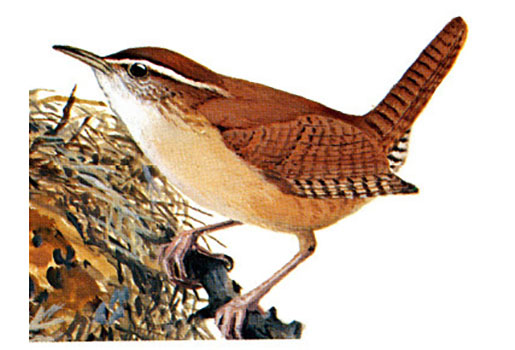
Carolina Wren
Thryothorus ludovicianus
Wren family (Troglodytidae)
Larger than House Wren. Brown back, cinnamon breast and belly, white throat, prominent white eyebrow. Short tail is usually cocked upwards.
Nesting:
Nests in natural tree cavities, woodpecker holes, building crevices, or artificial nest boxes. Eggs are creamy or pinkish-white with brown marks. Clutch size – 4 to 5 eggs.
Voice:
Song is a loud repeated 3-syllable series of notes, “tea-kettle, tea-kettle, tea-kettle.” Sometimes sings a 2-syllable series of notes, “kettle, kettle, kettle.” Song is similar to 3-syllable notes of Common Yellowthroat, but notes of Carolina Wren are louder and richer. Call is a raspy buzz, like running fingers across a comb.
Name Origin:
The genus name Thryothorus is from the Greek for "rushing reed." The species name ludovicianus is from Modern Latin for “of Louisiana,” referring to where the original specimen was collected.
In the Nature Park:
Year-round resident.
Photos:
Carolina Wren