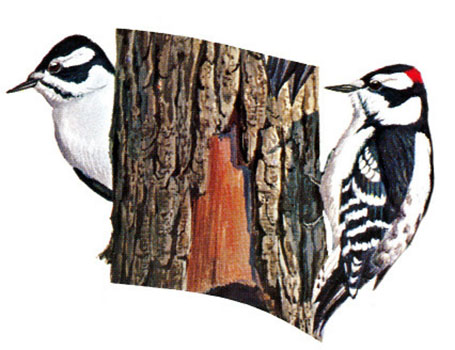
Downy Woodpecker
Picoides pubescens
Woodpecker family (Picidae)
A small woodpecker. Black-and-white checkered back, white underparts, black-and-white streaked face. Male has a small red patch on the back of his head. Bill is small, barely extending beyond the tufts of feathers at its base.
Nesting:
Cavity nester. Excavates nest near top of dead tree or in dead limb of live tree. Eggs are white. Clutch size – 3 to 8 eggs.
Voice:
Two common calls, a “pick” and a “rattle.” The Downy Woodpecker says “pick” with a flat or chirping sound, sounds conversational, not urgent. The rattle is a short series of notes, starting at the same pitch as the "pick" call, then descending in pitch.
Name Origin:
The common name “downy" refers to its shaggy and hairy appearance. The genus name Picoides is from the Latin for "woodpecker." The species name pubescens is from the Latin for “downy.”
In the Nature Park:
Year-round resident.
Photos:
Downy Woodpecker female (left) and male (right)