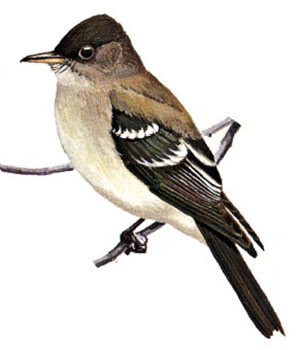
Eastern Wood-Pewee
Contopus virens
Flycatcher family (Tyrannidae)
A medium-sized flycatcher. Grayish olive back, two white wing bars. Sits in upright position typical of flycatchers. Does not flick wings or wag tail.
Nesting:
Nest usually located on a dead limb in a living tree, far from trunk, covered with lichens, inconspicuous. Eggs are creamy white with dark marks at one end. Clutch size – 2 to 4 eggs.
Voice:
Song is like its name – a distinctive whistled “pee-ah-wee” or a shorter two-syllable “pee-oo.”
Name Origin:
The genus name Contopus is from the Greek for "short foot" referring to the bird's small feet. The species name virens is from the Latin for “greenish.”
In the Nature Park:
Neotropical migrant, arrives by early May. Common in upland forests of the Nature Park. Distinct song is easily heard and recognized.
More Information:
The Eastern Wood-Pewee is about the same size as the Acadian Flycatcher but the Eastern Wood-Pewee forages quietly and usually perches on dead limbs of trees. The Acadian Flycatcher, in comparison, tends to vocalize while foraging and usually perches on live limbs. The Eastern Wood-Pewee is more brownish whereas the Acadian Flycatcher is more greenish.
Photos:
Eastern Wood-Pewee