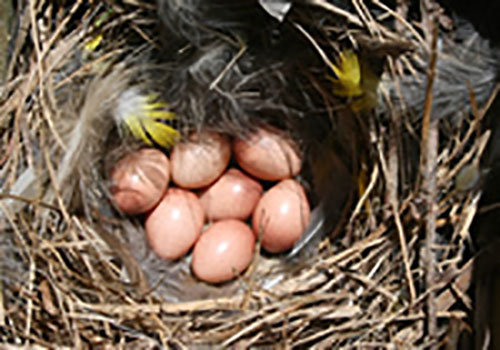
House Wren
Troglodytes aedon
Wren family (Troglodytidae)
A small bird with a big voice. Short tail is often cocked. Body is brownish gray, throat and chest are light gray.
Habitat:
Forest edges, shrubby thickets.
Nesting:
Nests in cavities in trees, fence posts, or stumps, and nests in artificial nest boxes. Clutch size – 4 to 8 eggs.
Voice:
Song is exuberant, a cascade of bubbling whistled notes. Calls include a series of short scolding buzzes and a rattle-like “churr.”
Name Origin:
The genus name Troglodytes is from te Greek for “cave dweller.” The species name aedon is from the Greek for a songstress from Aedon.
In the Nature Park:
Short-distance migrant, arrives in April.
Photos:
House Wren
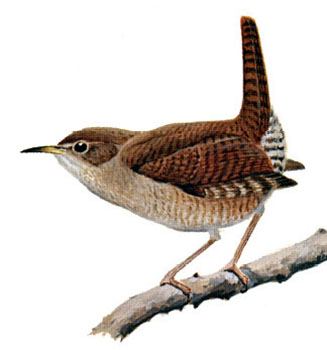
House Wren nest and eggs