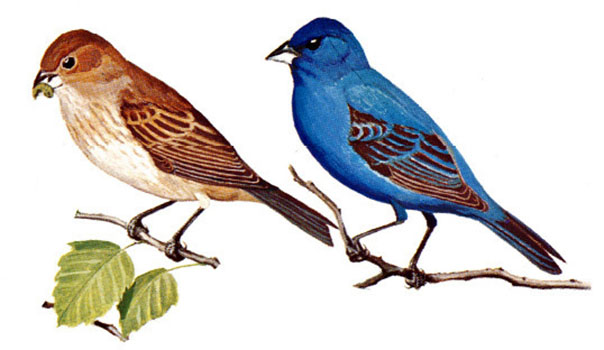
Indigo Bunting
Passerina cyanea
Cardinal family (Cardinalidae)
A small bunting. Male is deep indigo blue but may look black or brown unless the sun is shining directly on it. Female is brown with faint wing bars and faint streaking.
Habitat:
Forest edges, forests with dense understory vegetation, shrub thickets.
Nesting:
Cup-like nest, placed 1 to 2 feet above the ground (usually about knee-height) in the fork of a shrub, low tree, or a stout herbaceous plant. Eggs are white. Clutch size – 3 to 4 eggs.
Voice:
A rapid series of paired whistles, like “tsee tsee tew tew teer teer.” Call is a flat “spit”.
Name Origin:
The genus name Passerina is from the Latin for “sparrow-like.” The species name cyanea is from the Greek for “dark blue.”
In the Nature Park:
Neotropical migrant. Abundant in dense understory vegetation along the Creekside Trail.
Photos:
Indigo Bunting female (left) and male (right)