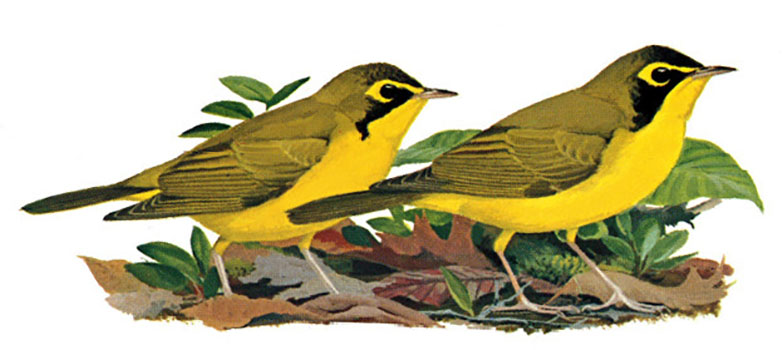
Kentucky Warbler
Geothlypis formosa
Warbler family (Parulidae)
Bright yellow throat, breast, and belly; olive-green back; bold yellow “spectacles.” Male has black on crown, under eye area, and on sides of neck. Female has less black on head.
Habitat:
Mature deciduous forest with dense understory vegetation.
Nesting:
Nest is an open cup built on the ground in dense understory vegetation at the base of a shrub or tree. Eggs are creamy white with brown marks. Clutch size – 3 to 6 eggs.
Voice:
Song is a rich and rolling series of two-syllable notes, like “chur-ree chur-ree chur-ree.” Song is similar to Carolina Wren’s but the Kentucky Warbler puts emphasis on the second syllable – “chur-ree chur-ree – whereas the Carolina Wren puts emphasis on the first syllable – “tee-kettle tee-kettle” or “tee-kle tee-kle.” Call is a low rich “chuck.”
Name Origin:
The genus name Geothlypis is from the Greek for "earth-dwelling finch." The species name formosa is from the Latin for “beautiful.” The common name “Kentucky” refers to the state where early ornithologists observed it in abundance.
In the Nature Park:
Neotropical migrant, arrives in mid to late April.
Photos:
Kentucky Warbler female (left) and male (right)