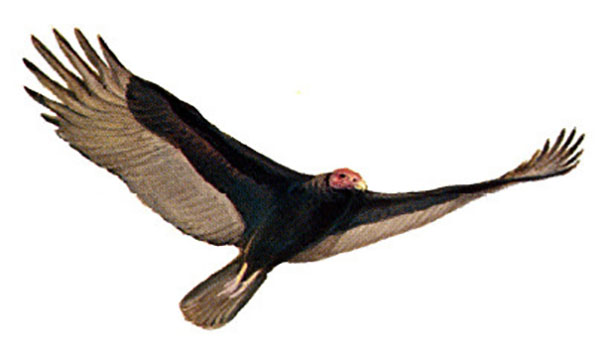
Turkey Vulture
Cathartes aura
Vulture family (Cathartidae)
A large dark bird. Wings are long, broad. Wingspan is 6 feet. Undersides of wings are silvery gray along the entire trailing edge of each wing. Head and neck are reddish, unfeathered.
Habitat:
Open country.
Nesting:
Male and female are socially monogamous, mate for life. No nest is constructed. Female lays eggs on the ground in a cave or on a rock ledge. Two large eggs are dull white, occasionally with dark marks. Nestlings are altricial, fly 9 weeks after hatching. Adults are very shy around their nest and will abandon nest if disturbed by humans.
Voice:
Grunts and hisses at nest site.
Name Origin:
The genus name Cathartes is from the Greek for "purifier". The species name aura is a South American name for this bird.
In the Nature Park:
Year-round resident. Turkey Vultures soar over the open quarry pit and perch and roost in trees on the cliffs along the Rim Trail. The quarry is ideal for Turkey Vultures because the sun heats up the Quarry Bottom, creating thermals of rising hot air for Turkey Vultures to soar on. Turkey Vultures can hop off the quarry rim and start soaring immediately with a minimum of energy required to begin flying.
Photos:
Turkey Vulture