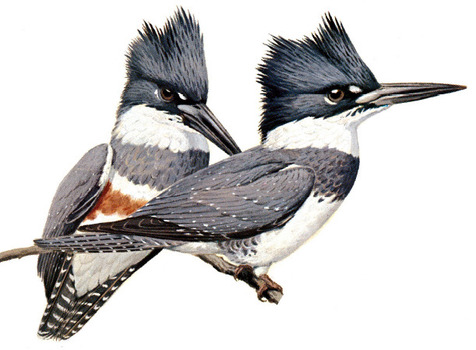
Belted Kingfisher
Ceryle alcyon
Kingfisher family (Alcedinidae)
Stocky body, large head, ragged crest of feathers on head, large bill. Head, back, and wings are bluish-gray. Belly and collar are white. Female (left in image) has blue-gray and rufous bands across belly. Male (right in image) has a single blue-gray band across belly.
Habitat:
Near water, rivers, lakes.
Nesting:
Nests in a burrow in a stream bank. Both male and female excavate tunnel, 1 to 2 m deep in bank. Eggs are white. Clutch size – 5 to 8 eggs. Fledglings leave nest about 4 weeks after hatching.
Voice:
A distinct rattle, varying in pitch, given in flight.
Name Origin:
“Kingfisher” literally means “chief of the fishers.” The genus name Ceryle is from the Greek, kerylos, for “seabird.” The species name alcyon is from the Greek for “kingfisher,” named after Alcyon who grieved so much after her husband drowned that the gods changed them both into kingfishers.
In the Nature Park:
Year-round resident. Kingfishers are regularly seen or heard along Big Walnut Creek and at the Quarry Pond.
Photos:
Belted Kingfisher female (left) and male (right)