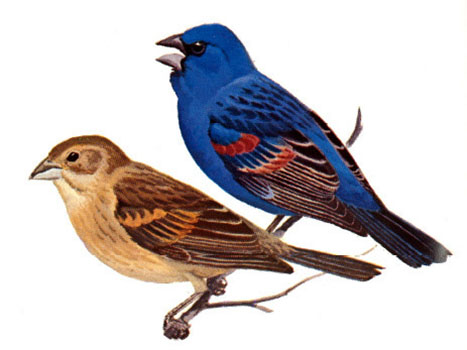
Blue Grosbeak
Passerina caerulea
Cardinal family (Cardinalidae)
A large seed-eating bird. Large gray conical bill. Male is dark blue overall with two reddish-brown wing bars and black feathers around base of bill. Female is brown overall, dark wings and tail, occasional blue feathers on upper parts, and two brownish wing bars.
Habitat:
Open meadows, forest edges.
Nesting:
Compact deep nest, placed 3 to 8 feet above the ground in a low tree or shrub, typically at the edge of an open area. Eggs are pale blue. Clutch size – 3 to 5 eggs.
Voice:
Song is a warbled phrase of musical notes. Call is a loud “chink”.
Name Origin:
The genus name Passerina is from the Latin for “sparrow-like.” The species name caerulea is from the Latin for “blue.” The common name “grosbeak” is from the French for "large beak."
In the Nature Park:
Neotropical migrant. Blue Grosbeaks have consistently been observed in the open meadows along the Quarry Trail on the northwest side of the Quarry Pond.
Photos:
Blue Grosbeak - female (left) and male (right)