Collaboration Thrives as Business Meets the Humanities
Each January, DePauw students embark on a broad selection of learning adventures both in Greencastle and around the world as part of the university’s winter term. This unique feature of the academic calendar celebrates curiosity and exploration, with current offerings including everything from an immersive study of France’s history and culture to an on-campus analysis of the science and practice of fermentology.
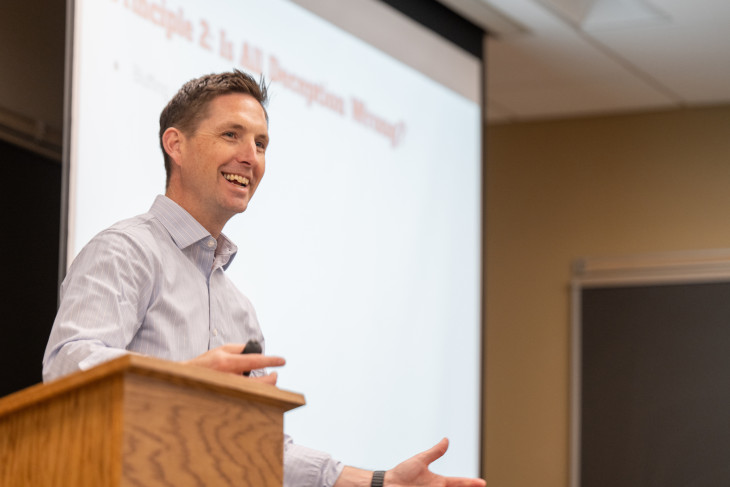
Jeff Dunn, associate professor of philosophy and director of the Prindle Institute for Ethics, understands the impact of DePauw’s winter term. Aided by a grant from the National Endowment for the Humanities, Dunn spent last winter term pioneering new connections between business education and the humanities as he led a planning project to explore how these frequently overlooked connections can be embedded into DePauw’s curricular future.
“It started out with a bunch of faculty and staff reading groups in the summer of 2024,” Dunn explains. “Then we had a workshop in August where we had about 20 DePauw faculty and an outside speaker who came in to talk about why you might want to bridge business with the humanities and how you might go about doing it.”
Although these initiatives helped to build momentum and create space for faculty members from various disciplines to begin sharing ideas, the focal point of the project was a winter term course in January of 2025. That course brought together 15 students and a half dozen faculty members to explore new methods for interdisciplinary collaboration.
“It wasn't a normal class,” says Dunn. “It was more like a curriculum design lab. The different faculty members each had projects they were interested in that bridged business and humanities. Some of them were in history, some were in philosophy, some were in business analytics.”
Throughout the course, students and faculty worked together in various arrangements and combinations, creating a fertile environment for ideas to cross-pollinate. This structure prioritized creative collaboration while also empowering students to take a more active role in the curriculum development process.
“Over the three and a half weeks, we shuffled around and developed ideas for new modules, new courses or new pods we might make. We even had a draft of a new minor we were thinking about. It was a really cool three-and-a-half week intensive process. I think the students enjoyed being treated like collaborators rather than just pupils.”
The work is still ongoing, as Dunn and his collaborators steadily transform some of these ideas into reality. Dunn hopes that this will open the door for opportunities such as team teaching, a new minor and other tangible additions to DePauw’s curricular offerings. In the meantime, he recognizes the tremendous value that the process has already generated for all those involved – especially the students,
“One thing that stood out about the winter term course is that it was a really uncomfortable way of teaching for a lot of us – in a good way. Most of us were used to having a lot of control over the syllabus and knowing where we were going to go. But part of the nature of this project is that we only had a rough idea, and then we just let the students, together with the faculty members, start reading and digging in and researching.”
Dunn refers to this pedagogical approach as “teaching on the edge.” Although it can be disorienting for the faculty members who find themselves relinquishing a certain measure of control, this intentional openness has a powerful effect.
“It's exciting to learn new things,” says Dunn. “It's easy as a faculty member to get in a rut and get used to teaching what you teach. But we're curious people. It's part of the human drive to learn new things. Pushing that boundary shows the excitement of learning. It reminds us why this is interesting in a genuine way.”
Browse other stories
-
Athletics
-
Women's Soccer - Katharine Lacy Makes Game Winning Goal Against Franklin
-
Men's Soccer - Last Minute Penalty Kick Goal Lifts Tigers Above Fighting Engineers
-
Volleyball - Proeh Selected NCAC Athlete of the Week
More Athletics
-
-
News
-
DePauw and Wabash Announce Venue for 132nd Monon Bell Classic
-
DePauw Earns Positive Outlook from Moody's, Backed by Record Philanthropy and Financial Growth
-
DePauw Students Return to Top Three of Risk Management Competition
More News
-
-
People & Profiles
-
In Brian Wright’s Lab, Student Research Meets Real-World Impact
-
Empie, Party of Five: One Family’s Unique DePauw Bond
-
Entrepreneurs Eric Fruth ’02 and Matt DeLeon ’02 Are Running More Than a Business
More People & Profiles
-
-
Have a story idea?
Whether we are writing about the intellectual challenge of our classrooms, a campus life that builds leadership, incredible faculty achievements or the seemingly endless stories of alumni success, we think DePauw has some fun stories to tell.
-
Communications & Marketing
101 E. Seminary St.
Greencastle, IN, 46135-0037
communicate@depauw.eduNews and Media
-
News media: For help with a story, contact:
Bob Weaver, Senior Director of Communications.
bobweaver@depauw.edu.