Winter Term Students Explore Life in a Single Sentence
On the last day of his winter term course titled “One Beautiful Sentence,” professor Timothy Barr showed his students an image of a palimpsest, an ancient manuscript page that had been scraped of its original writing to create a clean space for new text. In days when writing supplies were hard to come by, this practice allowed scribes to recycle and reuse the limited materials available to them. For Barr, the palimpsest illustrated a key skill he hoped his students would take with them following the three weeks they had spent together: an ability to embrace the messiness of the creative process.
“I had originally planned to title this course ‘One Perfect Sentence,’” he told the students. “But I realized that the idea of perfection gives the wrong impression. There’s a beauty in writing and erasing.”
For much of January, Barr and his students immersed themselves in the intricacies of the aphorism, a genre that specializes in taking broad observations and packaging them into compact, memorable statements. Students not only read a sampling of aphorisms from writers both old and new, but they also composed their own aphorisms – an in-depth process that involved peer input and multiple revisions. Through it all, the class learned to appreciate writing in a fresh way by analyzing literature in one of its most condensed forms.
“My scholarship draws upon the history of rhetoric, and aphorisms are one of the rare contemporary forms that clearly show their indebtedness to this tradition,” says Barr, assistant professor of communication and theatre at DePauw. “Working on developing a single sentence across three weeks obviously means we are engaging the process of writing differently than we normally do. It allows us to talk about the stylistic techniques that experienced prose writers use and recognize, but which are rarely taught.”
A Practical Exercise
Barr finds this discipline especially useful during the current moment of upheaval brought about by generative AI. As new technology impacts – or, in some cases, even replaces – student writing, he sees undeniable value in the time spent contemplating a single word or the placement of a particular punctuation mark. It’s an act that enriches every student’s academic journey, regardless of whether or not they view writing as a primary interest.
Megan Stieglitz ’29 is a perfect example. “I hate writing and anything to do with writing,” she says. “Papers are my worst assignments. I’m a numbers person. I want to be a sports data analyst, so this was very out of my comfort zone.”
Yet even for someone like Stieglitz, an entire winter term studying aphorisms left an impact.
“Being able to write down my thoughts freely in this class and not necessarily worry about the perfection of it was really nice,” she says. “That was probably one of my biggest takeaways. I feel more free and more confident. It doesn't have to be perfect. I can go through trial and error.”
On the other end of the spectrum, Jordan Heaviland ’29 entered the course with an existing passion for writing and a desire to hone his skills. His main interest is poetry, and he saw aphorisms as a genre ripe for exploration.
“I took this class to get techniques and work on certain writing skills,” he says. Through the work he did within the class and the conversations he enjoyed with Barr during office hours, Heaviland now sees himself as a more competent writer. “I learned how to take the proper risk with ambiguity and make sure that just enough of the subtext is communicated. I'm glad I took this class. It definitely gave me tools for the future.”
A Reflective Exercise
As much as the class focused on the nuances of style and literary texture, it also managed to venture into the deep waters of philosophical reflection. Aphorisms often take an unflinching look at the world, and Barr’s class didn’t shy away from those tough conversations. Through class discussions and group interactions, students wrestled not only with form and language, but also with questions of meaning, purpose and the complexity of human experience.
“I appreciated the ways we debated and the ways we talked about things openly and honestly,” says Kam Shiver ’29. “In one specific discussion we got into some deep topics that are really hard to talk about. But everyone handled it so well. It showed us that when you approach things with an open mindset and kindness – instead of just looking to argue with someone – you can learn a lot.”
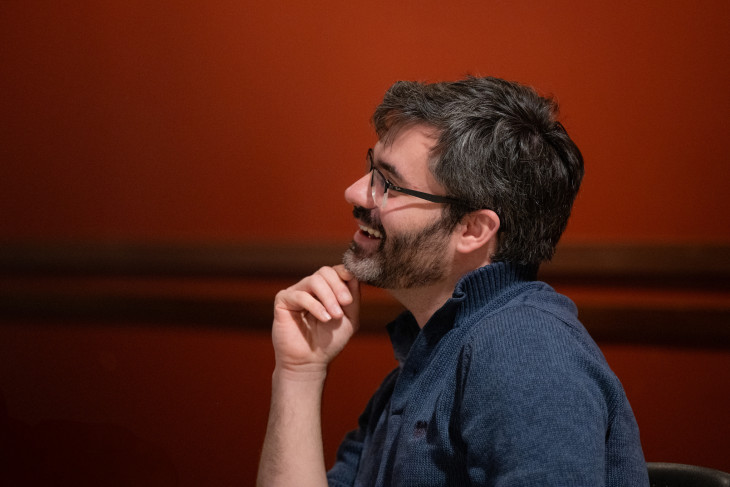
The open environment that Shiver describes is intentionally built into the structure of winter term itself. With three weeks to devote to a single course and topic of study, this unique window in the academic calendar allows ample space for contemplation, dialogue, and deep dives into topics that might otherwise get overlooked. It also allows faculty members to explore creative applications of their own scholarship and engage with students in fresh ways.
It’s one of the things that drew Charlie Hawk ’26 to the class in the first place.
“I had taken Professor Barr before, so I knew the classroom environment he was going to have,” says Hawk. “At this stage in my college career, it's more about picking a professor than picking a course. I knew I liked him and respected him a lot. He very much wants open critique, open communication. He levels with students like they're fellow thinkers, like they're exploring an idea that he is genuinely interested in.”
Hawk’s experience lived up to those expectations. Although he acknowledges that there was an awkwardness at first while everyone adjusted to each other, it soon gave way to a well-earned trust. “At the end, there was a connection we built by talking about sensitive, deep topics that we were writing about repeatedly,” he says.
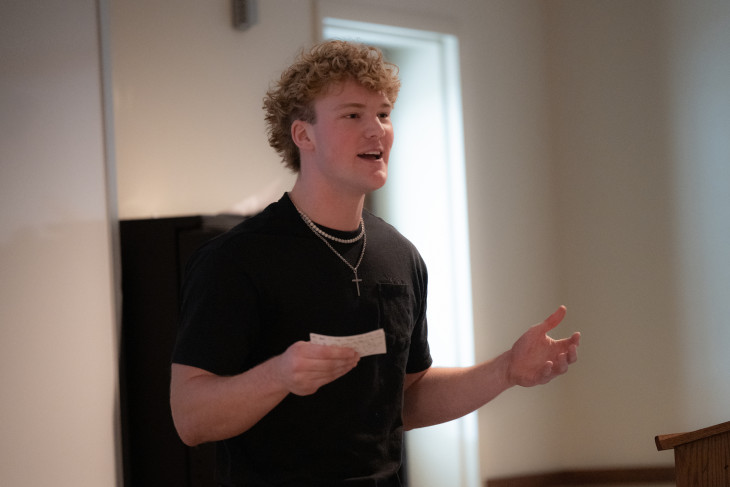
That’s not to say that the mood was always somber and heavy. Barr also created space for laughter and fun. For one of the days, he replaced the typical class session with a “sentence soirée,” where students gathered in a casual environment and played games. Each of them also performed an aphorism they had memorized, with a winner being chosen by class vote at the end.
Long-Term Impact
Barr believes the impact of a course like this extends far beyond the class sessions and assignments. In the same way that an aphorism can condense a wealth of insight into one concise statement, Barr hopes that these three brief weeks of winter term will have an outsized effect, reframing the way his students step into the futures before them.
“This class is organized around a way of processing all the uncertainty of life,” he says. “This is precisely the difference of a liberal arts education: it prepares you not only for your career, but also for your early mornings and difficult nights, your best and worst years. I hope that this short class is one piece of equipment that helps our students respond to the unique call given to their lives.”
Browse other stories
-
Athletics
-
Women's Soccer - Katharine Lacy Makes Game Winning Goal Against Franklin
-
Men's Soccer - Last Minute Penalty Kick Goal Lifts Tigers Above Fighting Engineers
-
Volleyball - Proeh Selected NCAC Athlete of the Week
More Athletics
-
-
News
-
DePauw and Wabash Announce Venue for 132nd Monon Bell Classic
-
DePauw Earns Positive Outlook from Moody's, Backed by Record Philanthropy and Financial Growth
-
DePauw Students Return to Top Three of Risk Management Competition
More News
-
-
People & Profiles
-
In Brian Wright’s Lab, Student Research Meets Real-World Impact
-
Empie, Party of Five: One Family’s Unique DePauw Bond
-
Entrepreneurs Eric Fruth ’02 and Matt DeLeon ’02 Are Running More Than a Business
More People & Profiles
-
-
Have a story idea?
Whether we are writing about the intellectual challenge of our classrooms, a campus life that builds leadership, incredible faculty achievements or the seemingly endless stories of alumni success, we think DePauw has some fun stories to tell.
-
Communications & Marketing
101 E. Seminary St.
Greencastle, IN, 46135-0037
communicate@depauw.eduNews and Media
-
News media: For help with a story, contact:
Bob Weaver, Senior Director of Communications.
bobweaver@depauw.edu.