In Brian Wright’s Lab, Student Research Meets Real-World Impact
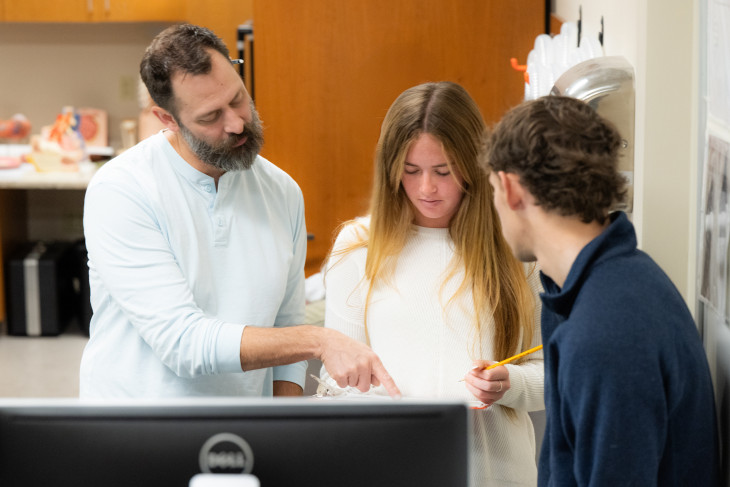
In 2023, the National Federation of State High School Associations (NFHS) approached DePauw kinesiology professor Brian Wright with a substantial request. The organization, which oversees many of the rules and regulations for U.S. high school athletics, had been receiving inquiries about the approval of a device for backstroke swimmers commonly known as a “wedge.” At higher levels of competition, these wedges are often placed against the wall of the pool at the start of a race to give backstrokers added leverage and traction while pushing off. Up until that point, however, their use in high school competitions had been prohibited out of a concern for athlete safety.
The NFHS was facing an important decision. They were responsible for determining whether or not the guidelines about wedges should be revised, but in order to do so, they needed research and data. That’s where Wright came in.
“From the kinesiology perspective, it’s our role to help individuals collect information and measure metrics that allow them to make a decision,” says Wright. “Our goal isn’t to bring about changes. Our goal is simply to provide decision-makers with all the information necessary.”
Wright took up the challenge. With over two decades of research experience investigating various aspects of swimming safety — including a prior collaboration with the NFHS — he was well positioned to give the organization what it needed. But he had no intention of carrying out the project alone. This was an endeavor that would require teamwork.
From the Kitchen to the Lab
Wright’s path to kinesiology started in an unexpected place. After graduating high school, he enrolled in a culinary school on the East Coast, fully intending to become a chef. But after watching some of his friends take a more academic route, he started to have second thoughts. Wright realized that he wanted a different type of educational journey — one that would allow him to continue his career as a swimmer and also open up new doors of academic discovery. He found both by transferring to SUNY Brockport.
“During my time there, I fell in love with the idea that you could study human performance in sport and incorporate principles of science to learn about sport performance,” says Wright. “The advisors I had at the time were really helpful to encourage the idea of exploring what it is you’re interested in. I enjoyed the learning process more than anything. I figured out what motivated me to learn, and I was suddenly really interested in what I was learning.”
That appetite took Wright to graduate school, first to the University of Pittsburgh and then to Indiana University. This allowed him to continue nurturing his love of learning while also remaining highly involved in the world of swimming and coaching.
When a position at DePauw opened up in 2013, Wright applied. Through previous research collaborations, he had already developed a familiarity with the university and its swimming program. But what sealed the deal was the opportunity DePauw provided Wright to invest in students.
“The reason I wanted to stay at DePauw was the focus on undergraduate education,” he says. “I had an opportunity when I was an undergraduate student to do student research, and it wasn’t something that my high school self would have thought I would be interested in. My thought was that I’d really like to work in a place where I could provide those same opportunities for others.”
A Team Approach
From that moment forward, Wright has consistently carved out space for students to join him in his research. Since the early 2000s, he has taken part in projects investigating various aspects of sports performance and safety, particularly in swimming. Through it all, he has made sure that students have the chance to play a part in the work alongside him.
“The main thing the research experience can provide undergraduate students at DePauw is a new approach to learning,” he says. “Oftentimes, they’re doing something they’ve never done. It’s a process they’ve never engaged with. As a part of that process, there's a lot of failing that goes on. Mistakes happen. The math doesn’t work. You encounter a lot of challenges you didn’t account for when you were planning. But we get to bring the student to a new level of thinking. We’re teaching through doing.”
From Wright’s point of view, the collaborative element is a crucial part of scientific discovery, especially in the discipline of kinesiology. The sooner students can realize that, the better.
“The image of a scientist in a lab by themselves is just not really how we work,” says Wright. “What I learned in graduate school that I try to share with students at DePauw is that the research process is very much a team effort. We’re working together, trying to answer questions that we’re all interested in. The team aspect plays a big part in that.”
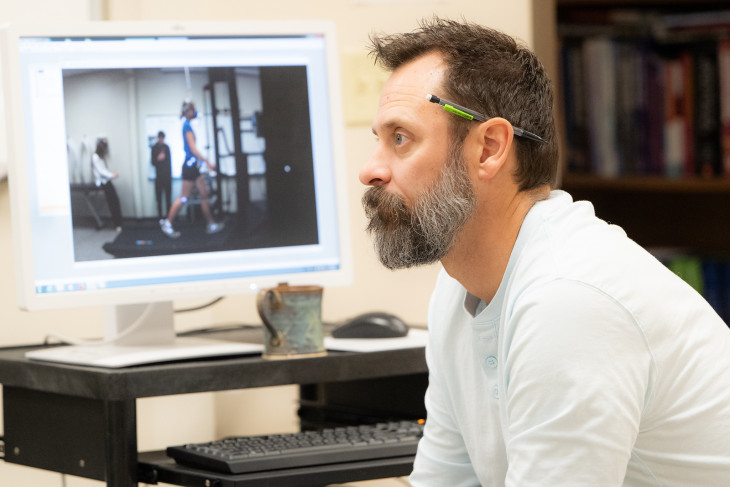
When it comes to undergraduate research, Wright and his colleagues take a flexible approach. On some occasions, a student’s interests determine the nature of the project. Perhaps they already have a specific question they’d like to answer or a particular experience they’d like to gain. In that case, Wright is able to build a custom project that matches the student’s goals with the expertise and equipment he and his colleagues already possess.
But on other occasions, Wright comes to his students with an existing problem that needs to be solved — just as he did when the NFHS reached out to him to help them collect swimming safety data about the backstroke wedge.
Faced with this important question that could potentially impact high school swimmers for years to come, Wright did what he had always done. He assembled a team and called upon his students to join the effort. They group quickly got to work, and together they carefully gathered all the information needed by the NFHS to issue an informed verdict.
“That project was fun, because it allowed about seven different students and a new faculty colleague within the kinesiology department at DePauw to get involved,” he says. “They helped plan the project. They traveled to Indianapolis to collect data. They worked with high school swimmers. And that project ended up leading the NFHS to change their stance and permit the use of the backstroke wedge in high school swimming.”
A Good Kind of Mess
Wright readily admits that incorporating undergraduate students into complex research projects like this one isn’t without its challenges. A sharp learning curve is inevitable, especially when working with students who are still adjusting to new levels of scientific rigor or experiencing lab work for the first time.
“The research process is very messy,” he says. “Undergraduate students may be less read in the field. They’re not always as well versed. But if the student’s motivation is there, if the student’s ambition is there, if the student’s desire to learn is there, then from my perspective it’s easy.”
Ultimately, Wright’s commitment to student research transcends even his own personal values as an educator. He sees it as something that represents the very heartbeat of a DePauw education.
“Our primary objective is student engagement; our second is research,” he says. “That might mean I could get the research done faster by myself as opposed to taking eight weeks longer if I have a student helping out. But that trade-off is the mission of DePauw. That trade-off is why we’re here. It’s what we believe in. It's what we value. And it’s the reason that particular student came to DePauw in the first place.”
Browse other stories
-
Athletics
-
Women's Track & Field - Stall Selected Academic All-America®
-
Women's Golf - Pair of Tigers Earn WGCA All-American Scholar Honors
-
Football - 2026 Monon Bell Game to be Played at Ball State's Scheumann Stadium
More Athletics
-
-
News
-
DePauw and Wabash Announce Venue for 132nd Monon Bell Classic
-
DePauw Earns Positive Outlook from Moody's, Backed by Record Philanthropy and Financial Growth
-
DePauw Students Return to Top Three of Risk Management Competition
More News
-
-
People & Profiles
-
Empie, Party of Five: One Family’s Unique DePauw Bond
-
Entrepreneurs Eric Fruth ’02 and Matt DeLeon ’02 Are Running More Than a Business
-
Rick Provine Leaves Legacy of Leadership and Creativity
More People & Profiles
-
-
Have a story idea?
Whether we are writing about the intellectual challenge of our classrooms, a campus life that builds leadership, incredible faculty achievements or the seemingly endless stories of alumni success, we think DePauw has some fun stories to tell.
-
Communications & Marketing
101 E. Seminary St.
Greencastle, IN, 46135-0037
communicate@depauw.eduNews and Media
-
News media: For help with a story, contact:
Bob Weaver, Senior Director of Communications.
bobweaver@depauw.edu.