Steeve Nsangou | Alum
At DePauw, I was encouraged to follow my passions by the mentors I worked with.
Steeve Nsangou Alum
Trading Places
Steeve Nsangou ’25 didn’t find out until the week before graduation that his proposal for a Fulbright research grant had been approved. Up until that point, his post-graduate plans had remained uncertain. But once the Fulbright email arrived in his inbox, Nsangou knew he’d been given a remarkable opportunity.
“This was the perfect mix of all the things I had done as an undergrad,” he says. “And it was packaged into an opportunity to be doing research in Japan. The universe has a way of making things work.”
Born in Cameroon and raised in Chicago, Nsangou had long been interested in Japan and what it represented. He had loved computers since he was a child, and he viewed Japan as the “mecca of everything technology.” If given the chance, he knew he wanted to visit one day.
That day came while Nsangou was at DePauw studying computer science with a minor in Japanese studies. Through a winter term course led by professors Hiroko Chiba and Dave Berque, Nsangou had the chance to travel to Kyoto, Hiroshima and Tokyo, all while exploring the country’s rich history of culture, technology and design.
“Being in a different environment really enamored me,” he recalls. “I was drawn by the idea of collectivism — the idea that the benefit of the whole is better than just the benefit of myself. The attention to detail and design in Japanese culture was really intriguing, as well.”
Nsangou returned to Japan the following summer for a research project, an experience that introduced him to the study of human-computer interaction. Before he knew it, this newfound subject of inquiry had quickly taken its place among Nsangou’s other diverse interests, such as music, dance and data analytics. His Fulbright proposal brought them all into one comprehensive project during his year in Tokyo at Chuo University.
“My research primarily focused on the impact of music on emotions in order to develop a music generation model that will improve the emotion of the listener,” says Nsangou. “My findings showed that the type of music and the personality type of the listener did have an impact on how positive or negative the listener’s emotion is. My next step is to create a user interface so that a new user can actually enter the necessary information and then have the music generated for them.”
At a professional and academic level, the Fulbright fellowship gave Nsangou invaluable experience presenting his work at conferences, expanding his understanding of research and becoming more comfortable working with colleagues from different backgrounds. At a personal level, Nsangou was also able to enjoy life in Japan, where he occasionally performed karaoke, traveled with friends and even volunteered at a local concert.
All of it proved just how powerful it can be to spend an extended amount of time in a relatively unfamiliar environment.
“The word that I would use to describe this experience is ‘growth,’” says Nsangou. “If everyone was able to trade places with each other for one year, I think the amount of human empathy — the ability to understand, the ability to have patience, the ability to see both sides — would really be strengthened.”
Nsangou plans to return to Japan in the near future for additional studies.
Our Community Stories
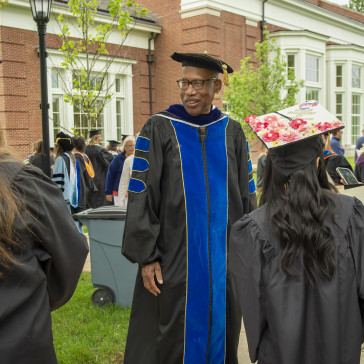
Empowering Students
Leslie James
Since I recognize that each student brings a unique dimension to the collective, it is problematic to…
Discover Leslie James
Hope Is the Solution
Bella Zollner
Bella Zollner ’27 isn’t the type to sit on the sidelines. She prefers to be in the heart of the action…
Discover Bella Zollner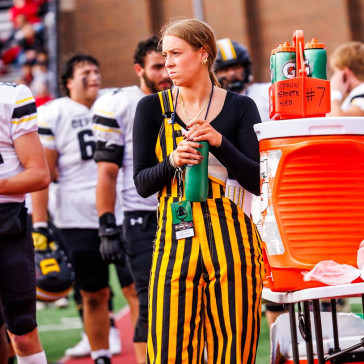
Where Passion Meets Opportunity
Arley Johnson
Since she was in high school, Arley Johnson ’26 has been intrigued by athletic training. As a track and…
Discover Arley Johnson