Orcenith Smith Is Still Making Music
Narrated by Drew Humphrey ’07, university communications writer
It’s the Thursday afternoon before spring break, and I’m suddenly alone in Kresge Auditorium, surrounded by silence and 1,500 empty seats.
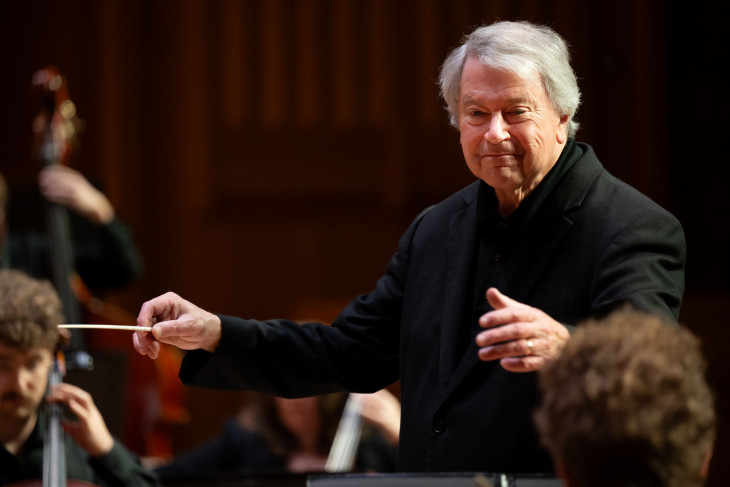
Up until a few minutes ago, I had been joined here by Orcenith Smith, professor of music and director of the DePauw University orchestra. For 52 years, Smith has filled this performance hall with some of the most beautiful symphonic music ever composed. But on this day, he was filling the space with music of a different kind: stories from a career devoted to education, integrity and the transcendent power of artistic expression.
I had originally reached out to Smith with the goal of learning more about his story and his commitment to a university that will soon recognize him with an honorary doctor of arts degree at its 187th Commencement ceremony. Over the course of an unhurried, hour-long conversation, he had answered each of my questions with a patient and poetic grace.
But then a door had opened at the far end of the room, and an unexpected visitor arrived eager to borrow a moment of Smith’s time. That was when Smith graciously excused himself, leaving me to finish up a few final notes on my own. As I did so, I couldn’t help but recognize that his sudden departure — and the quiet auditorium he left behind — told me more about his legacy than any of his stories ever could.
A Musical Background
Growing up in Oklahoma, Smith was surrounded by music from an early age. His father was a voice teacher and a full-time faculty member at the University of Oklahoma, his mother was an accomplished pianist and vocalist, and his older sister was a flutist who would go on to earn advanced degrees and pursue her own teaching career.
“There are pictures of me playing piano as my mother is guiding me,” says Smith. “There was music in the house in the evenings when I was playing or studying. I learned to play well because I heard it all the time.”
In his senior year of high school, Smith moved with his family to Ohio. His father had taken a new job at Wittenberg University, and Smith’s attention turned toward his own collegiate plans. By that point, his instrument of choice was the tuba, and he elected to continue his music education close to home at the Cincinnati Conservatory, where he became part of the honors and then conducting program. After graduating in 1973, Smith elected to stay in Cincinnati for his master’s degree — a decision that would shape the course of his life.
“While in my first year of graduate school, the job of orchestra director opened up at DePauw,” he recalls. “One of the professors at the Cincinnati Conservatory knew Donald White, the director of the DePauw School of Music at that time. He had reached out to see if there were candidates, and after interviewing in the spring of 1974, I was offered a full-time job.”
Committed to Student Success
Smith got right to work in his new role at DePauw. He was eager to create exceptional music along with his students, but he also knew he had a duty to prepare them for their own unique paths forward. He quickly came to see his job as a delicate blend of musicianship and mentorship.
“Orchestra directors look at repertoire as it pertains to what an audience might appreciate,” says Smith. “But they also look at what students need during their four years to prepare them for graduate school — or if they aren't going on to graduate school, what experiences they should have that prepare them for their work.”
This student-centered approach to music education became a hallmark of Smith’s career. As his role at DePauw steadily grew and evolved, his focus remained fixed on how he could best serve each individual under his tutelage, whether in the context of private lessons, classroom instruction or a performing ensemble.
“You don't necessarily know what kinds of students will be coming to you every fall,” says Smith. “But as you assess what they can do, it suggests the projects you can put them to work on. We have to live in the mind of that particular student in their development. We have to see how they go about what they're doing and how we can adjust what they're doing to accomplish more.”
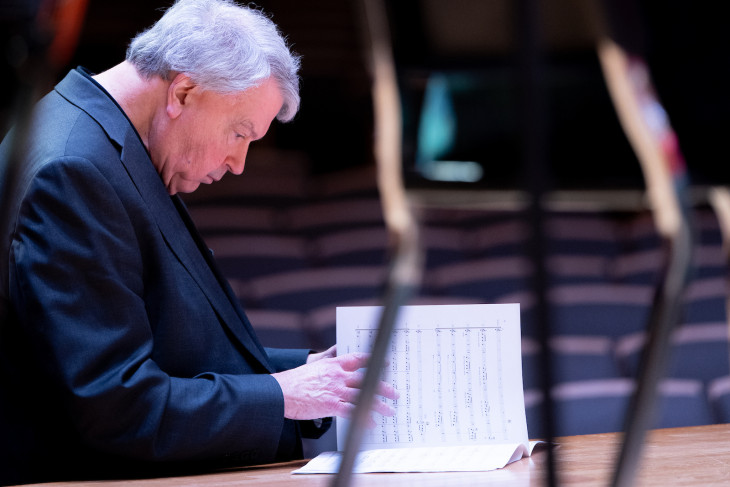
One of Smith’s intangible assets as an educator has been his understanding that no student chooses to study music arbitrarily. He recognizes that there’s something almost magical about the draw to music, and he’s remained intentional about using his position to help young people explore the nuances of that connection.
“Many students don't know what music means to them, except that it means something,” he explains. “If you could look down from above at a concert, what would you notice? You'd notice a bunch of people up on the stage, sawing away or blowing through their instruments. And then you’d notice the people at the other end sitting there, absorbing something through their ears, being moved by the music. They might find it difficult to talk about, but it's that emotional connection that brings our students to think that they would love to continue to participate in music. That emotion connects them with other people.”
Passion and Purpose
This connection is something Smith has experienced first-hand throughout his career. It’s why he’s kept showing up year after year to teach courses in symphonic literature, orchestration and conducting. It’s why he’s amassed over 900 performances of orchestral, operatic and choral-orchestral repertoire with all the groups he has conducted. And it’s why he’s led trips around the world to give students once-in-a-lifetime opportunities to perform in iconic venues such as Carnegie Recital Hall in New York, Terrace Theater in Washington, D.C, Minato Mirai in Yokohama and the Musikverein (Brahms Hall) in Vienna.
That emotional connection with music animates Smith’s own work as an artist. He has composed original scores for special occasions, including “A Monumental Moment” commemorating the birth of his daughter, a fanfare for Tony Blair’s visit to campus and arrangements for the annual holiday galas. He has also extended his career beyond the confines of Greencastle, holding music directorships with the Chicago Youth Symphony and the Indianapolis Philharmonic Orchestra and leading performances with the Seattle Symphony, the Oregon Symphony, the Indianapolis Symphony and more.
“At one point in my career, I was in four cities a week,” he says. “I've been blessed with good health. I thank my genetic forebears for that. But the music energizes me as well. I really don't want to miss a rehearsal if I can be there because I'm creating something with people who are expecting it.”
Smith has seen plenty of changes during his tenure at DePauw. Degree programs have come and gone. The School of Music has morphed into the Institute of Music. Students have gone from wanting to perform in a symphony orchestra to wanting to write music for video games. It’s the natural course of any career that spans over half a century. But Smith has weathered the changes by reminding himself of a simple principle: “A student’s willingness to come to DePauw means that we have a responsibility to teach them. Their commitment to the subject matter validates our responsibility to them.”
As a result of his dedication, Smith has been named “Outstanding Professor of Music” three times during his career at DePauw. He was also the inaugural recipient of the Cassel Grubb University Professorship in Music from 1999 to 2003. But perhaps more importantly, he has helped generations of students find their way into a life that is richer as a result of their experiences studying music.
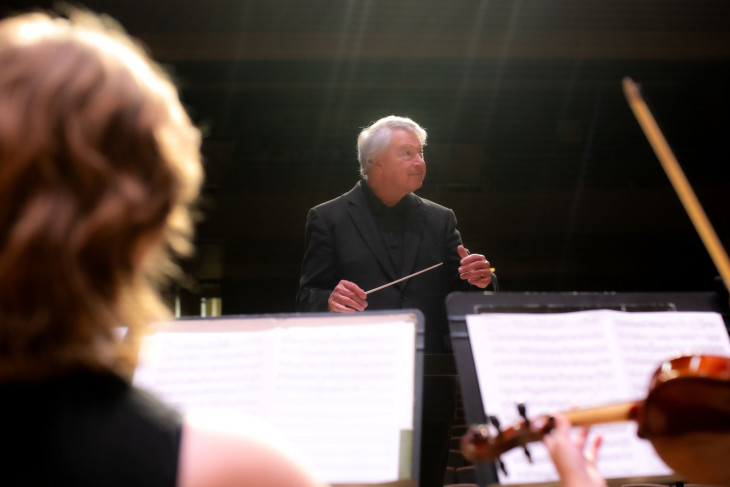
“Most musicians have grown up through this conversation that occurs between a private teacher and the student,” Smith says. “It's not that I started out in any way wanting to influence them. We just had conversations about educational initiatives. How is a piece of music constructed? How does an arts organization sustain itself? Some want to be able to perform for a living. Other students think about making a living in a different way. It’s all part of a longer pathway, and it's just enjoyable to have conversations with students about what they think they're interested in.”
The investment Smith has made into his students’ lives is hard to quantify. No single metric can do it justice. But perhaps one reliable indicator is the ease with which he rattles off a list of the impressive places some of his former students work in various capacities: the Detroit Symphony, the Peabody Institute at Johns Hopkins, the Cleveland Institute of Music, the Chicago Symphony, the Indianapolis Symphony — the list could go on.
And in fact, as we neared the end of our conversation here in Kresge, the list did go on when a door unexpectedly opened near the front of the auditorium.
An Ongoing Legacy
At the time, Smith had just started telling me about the shock he felt upon being informed that he would be receiving an honorary doctorate from the university. But at the sound of the door, he stopped mid-sentence and turned toward a voice calling out from across the room, “Professor Smith, do you remember me?”
Smith needed just one question to put the pieces together.
“What instrument did you play?” he asked.
“Viola,” was the response.
And then, immediately: “Yes! I do remember. You went back to Florida, didn’t you? Tell me about your life. What's going on?”
What followed was a joy-filled conversation between two old friends. Smith listened eagerly as his former student spoke about getting a master’s degree, taking up an artist-in-residence position and performing with a local symphony where she now lives. She had returned to campus with her friend and her sister, and she had had no intentions to leave without first tracking down her former orchestra director.
Smith was all smiles. He handed me back the microphone he’d been wearing, thanked me for the time we had spent together and then invited the new guests to join him at Cafe Roy for a cup of coffee and further conversation.
As they walked out of the auditorium, chatting about Stravinsky and Shostakovich, I was reminded of the words Smith had spoken to me just minutes before: “After students graduate, you often hear back from them. They’ll stop by for alumni weekend and leave a note on your door. If you're here long enough, you'll assemble those types of stories. You’ll get those appreciation letters from the students who come back remembering.”
I had now seen it play out right in front of my eyes, and it had punctuated our interview in the most fitting way possible.
Kresge Auditorium may have been quiet for the moment. But five decades after raising the baton for the first time here at DePauw, Orcenith Smith was definitely still making music.
Browse other stories
-
Athletics
-
Baseball - Bond Chosen Academic All-America®
-
Women's Golf - Becky Williams Selected as Amy Hasbrook Award Recipient
-
Football - Robby Ballentine Selected as Phil Eskew Award Recipient
More Athletics
-
-
News
-
DePauw Earns Positive Outlook from Moody's, Backed by Record Philanthropy and Financial Growth
-
DePauw Students Return to Top Three of Risk Management Competition
-
In Brian Wright’s Lab, Student Research Meets Real-World Impact
More News
-
-
People & Profiles
-
Empie, Party of Five: One Family’s Unique DePauw Bond
-
Entrepreneurs Eric Fruth ’02 and Matt DeLeon ’02 Are Running More Than a Business
-
Rick Provine Leaves Legacy of Leadership and Creativity
More People & Profiles
-
-
Have a story idea?
Whether we are writing about the intellectual challenge of our classrooms, a campus life that builds leadership, incredible faculty achievements or the seemingly endless stories of alumni success, we think DePauw has some fun stories to tell.
-
Communications & Marketing
101 E. Seminary St.
Greencastle, IN, 46135-0037
communicate@depauw.eduNews and Media
-
News media: For help with a story, contact:
Bob Weaver, Senior Director of Communications.
bobweaver@depauw.edu.