Professor Harry Brown Is Making a Lasting Impression
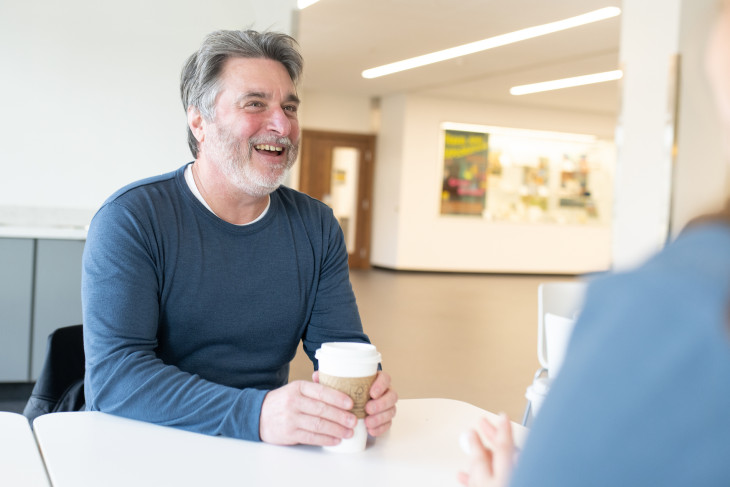
Harry Brown has been a beloved faculty member since he arrived at DePauw in 2003, but his outlook as an educator hasn’t always been what it is now. “When I first started, I saw myself as the young professor who could give students perspective, having been where they are not too long ago,” he explains. “It’s not that I felt like a peer, but I was close enough to their age where I could tell them that I know what it’s like to be in their position.”
That was over two decades ago. Since then, Brown’s perspective has gradually shifted along with the changes of his own life’s seasons. “There was a point where the ages of my kids were the same as the ages of my students. That was a defining moment for me, because I realized I was as old as their parents.”
For Brown, this realization helped unlock a new way of relating to the students that he worked with. He began seeing them through more of a parental lens, a shift that inevitably increased his empathy toward them and expanded his sensitivity toward the circumstances they face.
“When students have come to me with things – either academic or non-academic – I’ve tried to look at them as if this was somebody's son or daughter coming to their teacher for help. I ask myself: What can I do to help them get to the next thing? To help them overcome whatever they need to overcome? To be happy? To make the right decision? To have less anxiety over whatever it is they’re anxious about? I think getting older actually helped me to see them in a more sympathetic way.”
At the heart of this sympathetic approach is a deep respect for each student’s individuality. Brown has learned to pay attention to all the subtle ways they gradually reveal bits and pieces of themselves – whether it’s in a class discussion, a writing assignment or a simple after-class chat. From these, he can begin to discern how he can best come alongside them and offer support.
“Sometimes you see a student who needs something more or something different than the others in the classroom, so a big part of mentorship is discovering who needs what. They're all different. That’s why I tell students if you’re struggling, don’t be embarrassed. Everybody struggles. Just tell me what you need. Tell me what the problem is. There’s nothing we can’t work through.”
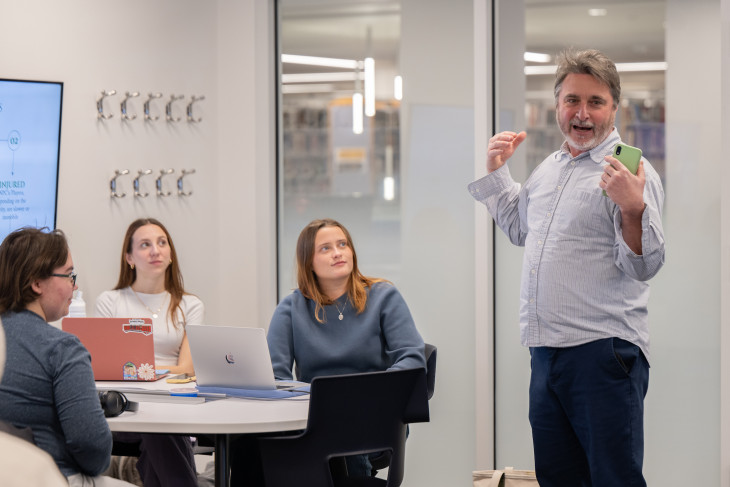
Claire Keefe Meadows ’21 was one of the many students whose life has been touched by Brown’s guidance and compassion. From the very first course she took with him, she recognized something special about the way he interacted with his class. “Right away, you could tell how passionate he was,” she recalls. “He always had an open door, and he was receptive to any kind of feedback. I knew a few of the courses I took with him were beyond what I was prepared for, but I still signed up just because of him.”
As an English major, a basketball player and a member of Kappa Alpha Theta, Meadows was highly engaged during her time on campus, and she sees Brown’s care for his students as emblematic of a much larger phenomenon throughout the university. “There was always a mentor somewhere,” she says. “That’s the thing about DePauw. People will go out of their way and take time out of their own lives. They want to help you.”
Although Meadows has moved on from DePauw – she recently graduated from Indiana University’s McKinney School of Law, started her legal career and married fellow DePauw alum Mason Meadows ’22 – she still keeps a memento of Brown’s mentorship. Before graduation, he gave her a book with a note of encouragement written on the inside – a personalized gift that he gave each of his advisees. Several years later, that book continues to serve as a small reminder of the big impact one person can make.
“Sometimes you don't see the impact of what you do until years after your students graduate,” says Brown. “That's the thing that always makes me laugh. If I have been a mentor, it's hard for me to see it at the moment. You’ll get a random email or a card or an invitation to a wedding, and only then do you start to realize the ripples outward.”
Browse other stories
-
Athletics
-
Volleyball - Proeh Selected NCAC Athlete of the Week
-
Field Hockey - Tigers Rebound With 3-1 Win Over Concordia Wisconsin
-
Field Hockey - DePauw Falls to Marian 2-3
More Athletics
-
-
News
-
DePauw and Wabash Announce Venue for 132nd Monon Bell Classic
-
DePauw Earns Positive Outlook from Moody's, Backed by Record Philanthropy and Financial Growth
-
DePauw Students Return to Top Three of Risk Management Competition
More News
-
-
People & Profiles
-
In Brian Wright’s Lab, Student Research Meets Real-World Impact
-
Empie, Party of Five: One Family’s Unique DePauw Bond
-
Entrepreneurs Eric Fruth ’02 and Matt DeLeon ’02 Are Running More Than a Business
More People & Profiles
-
-
Have a story idea?
Whether we are writing about the intellectual challenge of our classrooms, a campus life that builds leadership, incredible faculty achievements or the seemingly endless stories of alumni success, we think DePauw has some fun stories to tell.
-
Communications & Marketing
101 E. Seminary St.
Greencastle, IN, 46135-0037
communicate@depauw.eduNews and Media
-
News media: For help with a story, contact:
Bob Weaver, Senior Director of Communications.
bobweaver@depauw.edu.