Buried No More
DePauw Duo Uncovers a Town’s History – and Their Students’ Potential
Rebecca Schindler and Pedar Foss arrived in Italy last May optimistic about the season ahead. It was their third summer bringing students to work at Via Belvedere, an archaeological site just outside the town of Castiglione del Lago, and they were eager to build upon the progress they had already made.
By the time they hung up their pickaxes and trowels six weeks later, even their most ambitious expectations had been surpassed. Not only did their work uncover fresh insights about the structures buried on the hillside, but it also upended existing narratives about the entire history of the region. It was the type of breakthrough that many archaeologists only dream of – and one that earned a striking headline in the local newspaper: “Archaeological excavations rewrite the history of Castiglione del Lago.”
A Road Back in Time
Schindler is the scientific director of the Trasimeno Regional Archaeological Project (TRAP), a joint partnership between the Umbra Institute in Perugia and DePauw University.
Alongside Foss, her spouse and fellow professor of classical studies at DePauw, she’s learned through 35 years of fieldwork in the Mediterranean that the only predictable aspect of archaeology is unpredictability.
“We don’t know what we’re going to find,” says Schindler. “We might speculate about the answers, but until we actually do the work, we’re not going to know. We are truly working with primary data, with data that nobody in the modern world has ever seen before.”
That’s why the team came into the most recent season in Italy with a short list of theories and a long list of questions. What they knew for sure was that the site contained two distinct areas – one that resembled a Roman bath complex and another on the terrace just above it, covered in paving stones. Their research to date had generated some informed speculations about what the site might have been used for, but Foss and Schindler knew there were many mysteries left to unravel.
“This year we had two really important agenda items,” says Schindler. “We wanted to learn more about a particular room in the bath area. And we wanted to figure out what was happening with this pavement. That led to two big surprises.”
Regarding the bath complex, the team was able to open up a semicircular room that proved far more interesting than originally expected. Among their discoveries were several niches that likely would have held statues, a large water basin with marble steps leading into it and the remnants of what may have been a metal fountain. All of this evidence, when paired with the prominent location of the site on the hillside overlooking Lago Trasimeno, led Schindler and Foss to the possibility that this structure was something entirely different from Roman bath complexes typically found at residential Roman villas. They now suspect that the Via Belvedere structure was a monumental public bath complex, a unique discovery in the region of Umbria.
But perhaps the bigger discovery took place on the nearby terrace as the team explored new sections of the pavement that, according to Schindler, “was driving us crazy because it didn’t look Roman.” As it turns out, it wasn’t. In fact, it predated the Romans by several centuries.
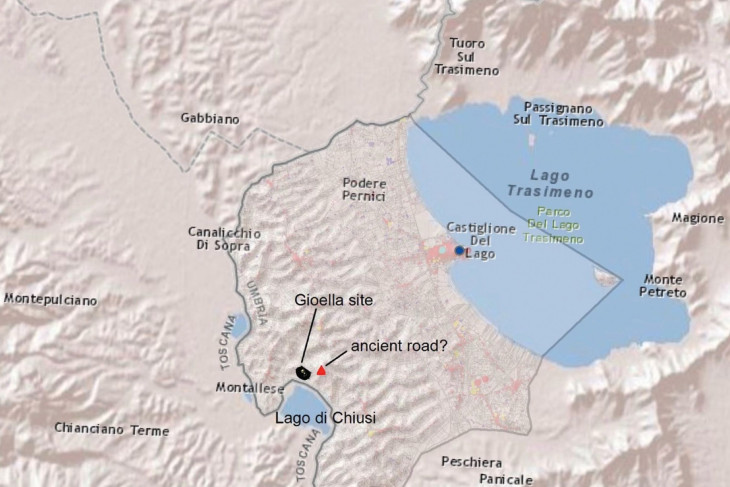 Map of Lago Trasimeno and the Territory of Castiglione del Lago.
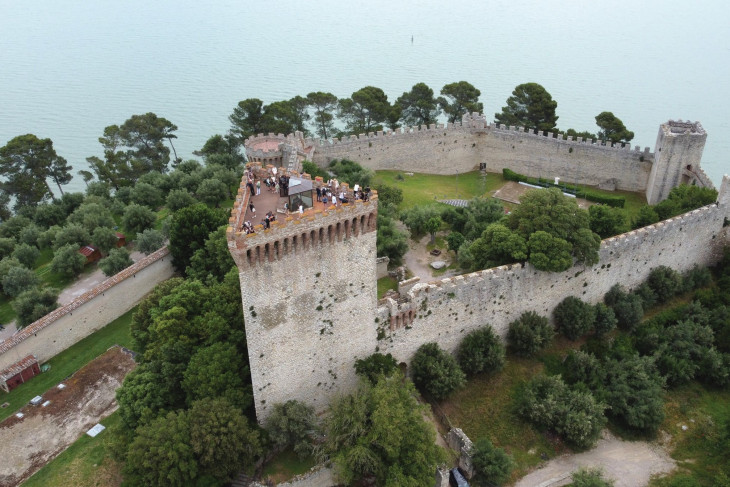 Rocca del Leone.
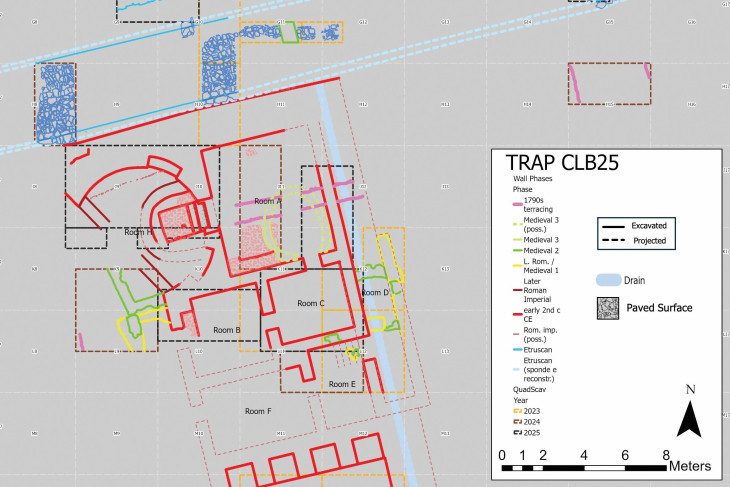 Site plan of the Trasimeno Project excavations at the Via Belvedere site.
Long before Rome ascended to a position of widespread power, the Etruscans enjoyed several centuries of cultural prominence. They occupied an area of Italy that roughly coincides with modern-day Tuscany and parts of Umbria, and although there had been some Etruscan artifacts previously unearthed at the Castiglione del Lago site, the relationship between this location and other nearby Etruscan settlements was not well understood. The team’s work is beginning to change that.
“We can now confidently say that this is a road dating back to the Etruscan period, as early as the sixth century B.C.E.,” says Schindler. “That pushes the history of this town back at least 500 years earlier than previous evidence.”
The most recent data collected by the TRAP team indicates that the paved road led up the hill to a major temple at its crest, designating this site as a place of deep religious significance. “All of the finds from this area suggest that people were making offerings to a deity,” Schindler says. “We just don’t know who the deity is. But if we’re right that this is an Etruscan sanctuary – and we feel like we’re 95 percent there – this would be huge. In this territory of Italy, there’s no other site like this.”
There’s still much work left to be done. Schindler and Foss tell their students that for every day they spend in the field, they should expect to need a month for documenting, analyzing and publishing their findings. But it’s clear that what happened on the hillside of Castiglione del Lago last summer will drastically impact the way the region understands and interacts with its past for years to come.
For Schindler, the team’s discoveries are proof of the remarkable power of archaeology. “History isn’t fixed,” she says. “The exciting thing is that every day we’re getting little bits of new data. We always have to be revising our hypotheses.”
Yet even as Foss and Schindler’s work transforms our understanding of the past, the most important result might just be the way that it shapes the futures of the students who join them in the field.
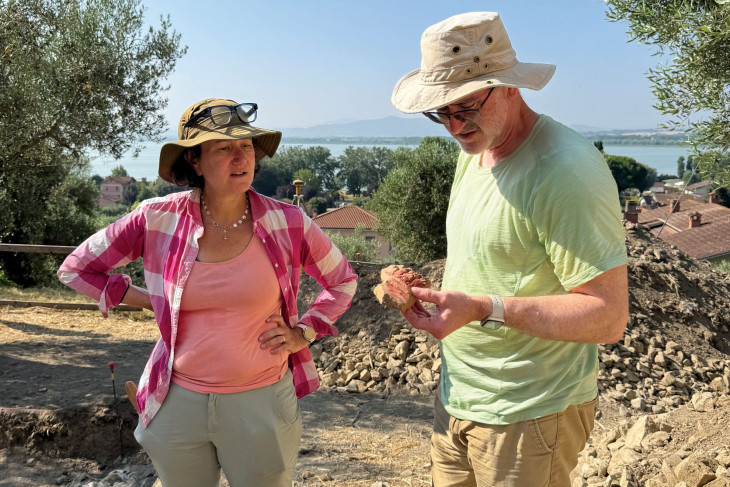 Rebecca Schindler and Pedar Foss examine a pottery sherd.
Education Beyond the Classroom
When Foss and Schindler joined DePauw’s faculty in 1999, they brought two important assets along with them: a wealth of archaeological field experience and a resolute commitment to hands-on education. They understood that some of the most potent moments in a student’s learning might not happen within the cozy confines of Asbury Hall, but rather at the bottom of a trench on a hot summer afternoon while covered in several layers of dirt and sweat.
Foss found this out for himself as an undergraduate at Gustavus Adolphus College in St. Peter, Minn. “I was a classics and chemistry major, and I had never been anywhere really,” he says. “The school got involved in a consortium to send students to Crete, and I applied to go over. All I could think about for four months was making sure I was one of the two students selected from Gustavus to go. And I was.”
The experience reoriented his entire life. “It was one of those situations where the first day I was on-site, I knew that was what I was going to do. It was literally a bolt of lightning from Zeus, and I don’t think that’s ever gone away.”
During their first several years at DePauw, Schindler and Foss brought students with them to do field work in Turkey, where the two of them had already been working since their days as graduate and postdoctoral students. But after that project came to an end in 2005, a sabbatical in Perugia during the 2013-14 academic year opened the door to new connections – and new possibilities – in Italy.
“We had the opportunity to start a field school,” says Schindler, “meaning an archaeological project that is designed to teach undergraduates the methods, theories and practices of archaeology in the field. It’s experiential education, and it was appealing to us, because we hadn’t had a field school for a while for DePauw students. We were also both at a place where we were looking for a new research project.”
The result was the highly collaborative and community-based TRAP initiative. Since its inception, Schindler and Foss have excavated three different sites in the region, including their most recent investigations at Castiglione del Lago. Their team is composed of professional Italian archaeologists and conservators, as well as undergraduate students representing a range of majors from DePauw and other universities in the United States. It’s an ideal environment for students to explore the ins and outs of archaeological work while simultaneously developing interpersonal skills that will serve them in any field they enter.
“It’s perfect really,” says Foss. “They have a core group of colleagues they know, but then they get to meet and work with students from a diversity of backgrounds. They all have to find a way to work together, so it’s really good modeling of what might happen out there in the next stage of their lives when they’re done with college.”
A Program for Everyone
For students like Ana Foutty ’27, TRAP represents a milestone of personal development. When she made her first trip to Italy during the summer of 2024, she already knew she loved history and was interested in archaeology. Yet working in the field pushed her in ways she couldn’t have expected.
“It was hard work, but I loved it,” she says. “It made me feel strong. There’s a lot of manual labor, so I felt like I grew physically. And it was also my first time going abroad by myself, so there was a lot of personal growth as well. It showed me that when you put in the time and put in the effort, you’re going to get the result.”
Foutty fell in love with the program, and she returned to Castiglione del Lago this past summer to take on an expanded role as an area supervisor. “The first summer taught me hard work. This summer was all about leadership – having to figure out how to work with students from all over and navigate the very important research with Schindler and Foss.”
As a history major, Foutty’s experience at the archaeological site has given her an entirely new perspective on everything she’s continuing to learn in the classroom. Yet she jokingly admits how this can have its downsides. “It’s both a blessing and a curse,” she says. “Part of the problem is now I open a medieval textbook, and I’m like, ‘Oh, boring. I just held a 2,000-year-old coin.’”
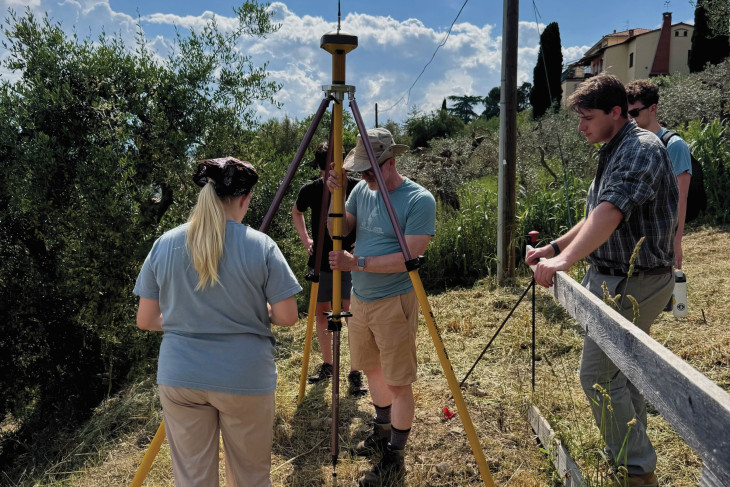 Pedar Foss and Ana Foutty ’27 set up the GPS equipment.
Even if a student’s long-term plans don’t include archaeology, TRAP provides a flexible environment for them to find – or create – their own niche. Schindler and Foss work with students to find out what they’re interested in, and then they carve out roles that allow everyone to achieve new levels of knowledge and skill.
One such student is Jimmy Anderson ’26. As a physics major who’s been flying drones with his dad for the last 10 years, Anderson’s career goals have always been more likely to land him in aerospace than archaeology. But while taking a Latin course with Foss during his junior year, he learned something that piqued his interest: the TRAP expedition could benefit from the addition of a skilled drone pilot. This would enhance their ability to secure high-quality aerial imagery for the purpose of creating detailed maps and models of the dig site.
Anderson jumped at the opportunity. It was an ideal outlet for him to utilize his expertise, while giving him a terrific excuse to spend six weeks living in the beautiful Italian countryside.
“You don’t need to be an archaeologist to have a good experience,” he says. Anderson particularly enjoyed the communal nature of the project, which allowed him to build deeper friendships with people he already knew and form new relationships with others he didn’t. “Everyone had different interests, and there were so many different perspectives. But you really get to know each other when you’re working with them in 100-degree heat.”
In the end, Anderson came away with a cache of lifelong memories and an expanded imagination for what his future might hold. “It’s given me an insight into a new career path,” he says. “Piloting drones has always been something I’ve been interested in, but I didn’t know I could apply it to something like this.”
Foss points out that students like Anderson aren’t the exception when it comes to this kind of research; they’re the norm. “This kind of work is inherently multidisciplinary. Anybody from any major or any background can get something out of it and contribute something to it.”
Foundations for Success
With so many years invested in mentoring and teaching, it’s no surprise that Schindler and Foss have built a legacy of impact. Many of the students who have accompanied them in the field have gone on to enjoy success at the next stage of their lives, building upon the skills they acquired while working on-site.
Rebecca Kerns ’19 is one of them. She’s currently finishing her Ph.D. in classics at the University of Cincinnati, and a crucial part of her journey was the time she spent in Italy with Schindler and Foss over the course of four different seasons.
“Each subsequent year, they scaffolded additional skill-building opportunities where I was able to develop my own research toolkit,” says Kerns. By her final year, she collaborated on a faculty-student research grant to develop a 3D photogrammetric modeling workflow and a digital site museum for the project – invaluable experience that continues to serve her today.
“Now that I’m pursuing my own career in archaeology, I still find it very grounding to think back to my time at DePauw,” Kerns says. “Schindler and Foss inspired me from the start and continue to be some of my best mentors in the field. They are models of what I aspire to be.”
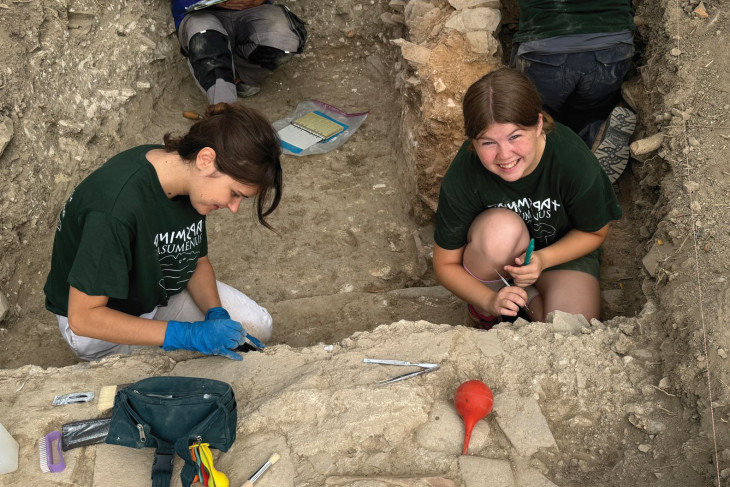 Jade Karas ’25 (right) working with the project conservator, Elena Roscini, to preserve Roman wall plaster.
Jessica Tilley ’17 was part of the first group to travel to Italy in 2015 after the partnership with the Umbra Institute was formed. As a first-generation college student, she had experienced homelessness and hunger prior to arriving at DePauw and had never heard of “classics” as a field of study. But after taking courses with both Schindler and Foss, she began to develop an interest that would change her life.
“They made the past come alive in a way I didn’t know was possible,” says Tilley. “In various ways, they showed me that regardless of one’s background, there is something to connect to in antiquity. The ancient world is accessible to everyone.”
Tilley is now a visiting assistant professor of classics at Centre College, and she also serves as the assistant director of excavations at the Montereggi Project in Italy. Looking back, she recognizes how formative it was to work in the
field with Schindler and Foss, and she traces much of her present outlook to the lessons she learned during that first encounter.
“It was my first archaeological experience as well as my first time abroad,” Tilley says. “Through their example, they showed me how to be a citizen of the world and how to responsibly navigate life abroad while getting the very most out of the cultural experiences. The field training I received laid a strong foundation for my career as an archaeologist.”
The Value of History
As Schindler and Foss reflect on their groundbreaking work this past summer in Castiglione del Lago – and on the archaeological progress they’ve helped facilitate for over three decades throughout the Mediterranean – they hope their discoveries can serve the people and communities living there.
“We’re researchers, so we’re qualified and skilled enough to have interests,” says Schindler. “But I’m very conscientious that ultimately, the site is not mine. It belongs to the community, and in the long term, it’s important for it to be a part of their story.”
Toward that end, one key initiative for the TRAP researchers has been the establishment of a new archaeological museum in the town. This would be the first of its kind in the region, offering an accessible way for local residents and visitors to connect to their past.
The benefit of that connection is hard to overstate.
“In times of uncertainty or stress or conflict, there are lots of useful lessons to learn from these past situations,” says Foss. “Humans aren’t really any different. We may have more powerful, faster and more deadly tools, but the human problems are comparable. Whether it’s social problems, political strife or environmental danger, these things are not new. People have faced them and documented them in the past, and there’s a lot we can learn from their responses. Sometimes if we paid a bit more attention to that wisdom, we might be more humble in how we approach problems today. We might be better listeners and more empathetic collaborators and contributors in our societies.”
To the cynic, digging up 2,500-year-old paving stones may seem irrelevant to the complex challenges facing our world in difficult times. But as Foss and Schindler have shown throughout their careers, maybe the answers we need are buried just beneath our feet.
Note: Photos and images courtesy of Pedar Foss and Rebecca Schindler.
DePauw Magazine
Spring 2026
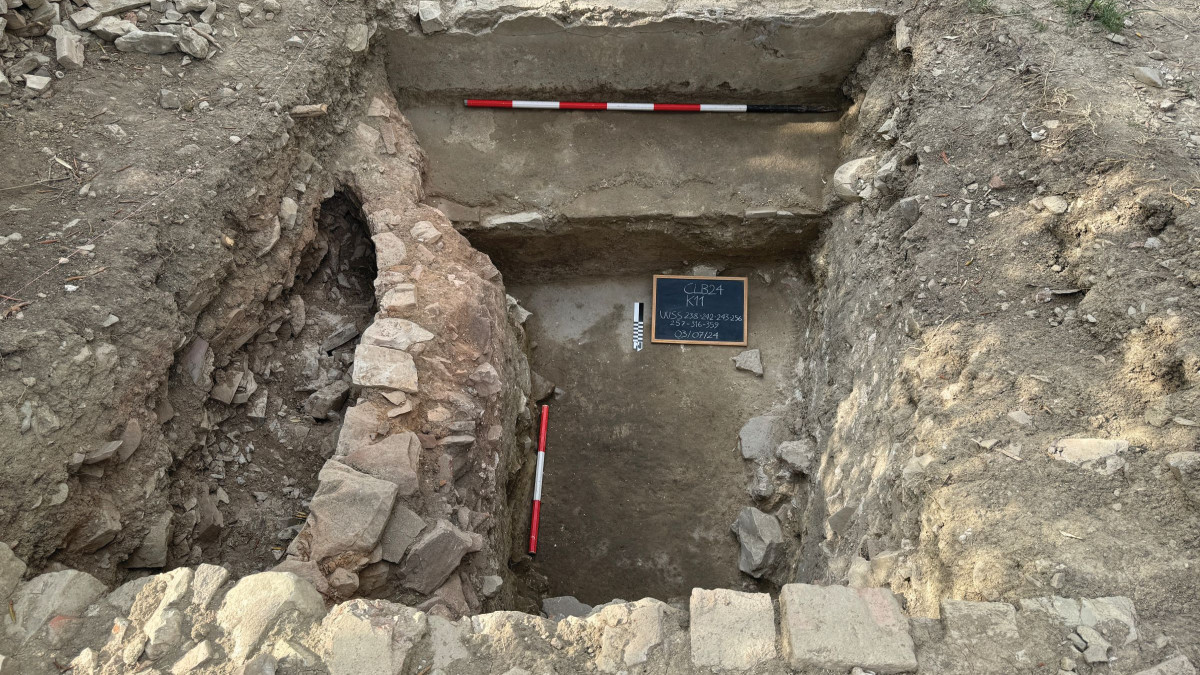 Buried No More
 The Tree of Learning
DePauw Stories
A GATHERING PLACE FOR STORYTELLING ABOUT DEPAUW UNIVERSITY
Browse other stories
-
Athletics
-
Football - #23 DePauw Moves to 4-1 with NCAC Win over Oberlin
-
Field Hockey - Tigers Remain Undefeated in NCAC with Win Over Allegheny
-
Women's Soccer - Tigers Finish in a 0-0 Tie with the Yeowomen
More Athletics
-
-
News
-
DePauw and Wabash Announce Venue for 132nd Monon Bell Classic
-
DePauw Earns Positive Outlook from Moody's, Backed by Record Philanthropy and Financial Growth
-
DePauw Students Return to Top Three of Risk Management Competition
More News
-
-
People & Profiles
-
In Brian Wright’s Lab, Student Research Meets Real-World Impact
-
Empie, Party of Five: One Family’s Unique DePauw Bond
-
Entrepreneurs Eric Fruth ’02 and Matt DeLeon ’02 Are Running More Than a Business
More People & Profiles
-
-
Have a story idea?
Whether we are writing about the intellectual challenge of our classrooms, a campus life that builds leadership, incredible faculty achievements or the seemingly endless stories of alumni success, we think DePauw has some fun stories to tell.
-
Communications & Marketing
101 E. Seminary St.
Greencastle, IN, 46135-0037
communicate@depauw.eduNews and Media
-
News media: For help with a story, contact:
Bob Weaver, Senior Director of Communications.
bobweaver@depauw.edu.