The Tree of Learning
By Chris White, senior professor of English, creative school special programs
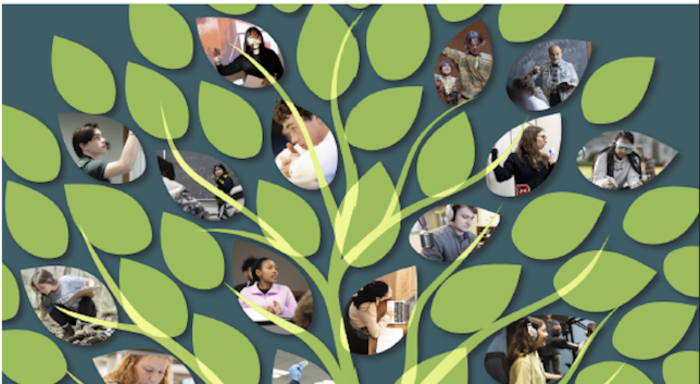
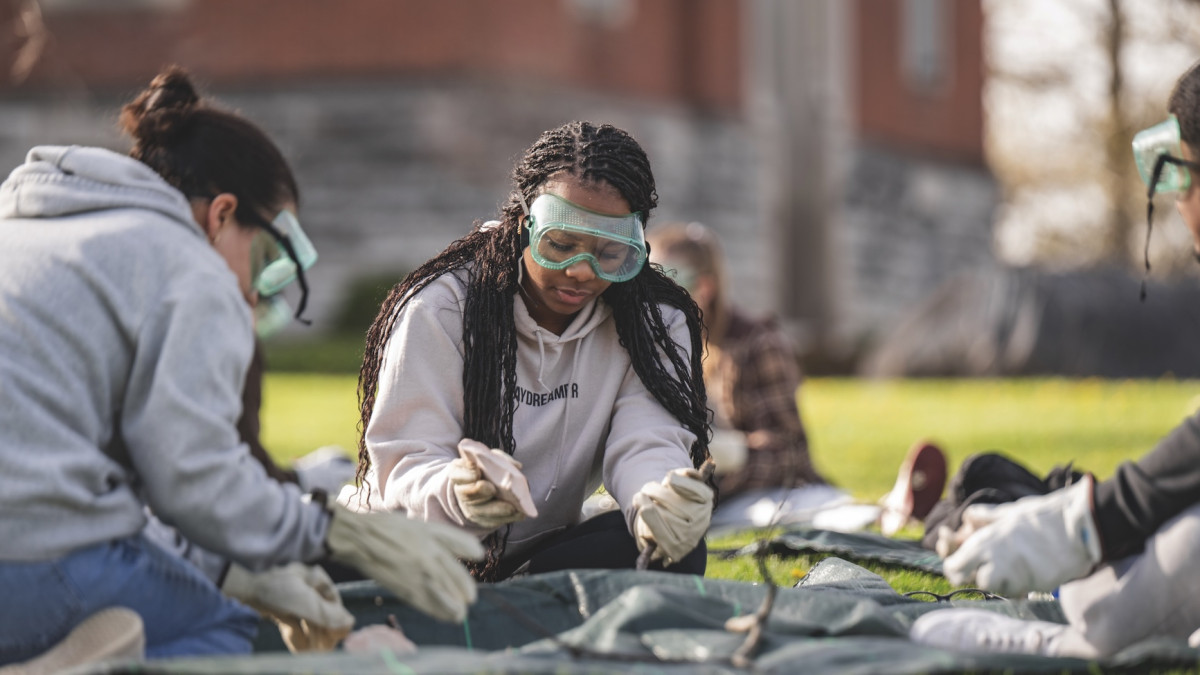
Let’s look at the college of liberal arts and sciences as the original tree standing at the center of the university. This tree, or the collected disciplines associated with a traditional liberal arts and sciences education, is rooted by knowledge gathered over centuries from cultures across the world, and it rises from the belief that knowledge is strengthened by access to other knowledge (the word “liberal” here from the Latin for free or unrestricted). It aims to cultivate a free-thinking individual who can see the world holistically, think critically, ask their own questions and draw their own conclusions.
The tree's branches stretch into majors, minors, interdisciplinary programs, fellows programs, study abroad programs, the Creative School and the School of Business and Leadership, all of which, in turn, sprout to produce branches of their own. Both stable and flexible, this majestic tree stretches wide and leafy, flowering every season and bearing abundant fruit: the great diversity of experiences DePauw offers its students.
With the thriving heartwood of the College of Liberal Arts and Sciences (CLAS) at our center, we preserve and expand our knowledge of history; the empathy, cultural intelligence and self-discovery we glean from literature and the arts; the centuries of inquiry and methodology that are the foundation for all scientific inventions and discoveries – psychological, chemical, technological, medical, environmental. We maintain access to philosophy’s chronicling of our search for meaning, the essential perspective acquired through political science, the mathematical theories and equations that enable us to solve problems from engineering to finance to data analysis. We continue the exploration of our fellow humans and their ancestors – their development, their behavior, their cultures – gathered through the study of sociology and anthropology.
...rooted by knowledge gathered over centuries from cultures across the world, and it rises from the belief that knowledge is strengthened by access to other knowledge.
The list goes on, and where there is life, there is evolution. The CLAS adapts to disciplinary and interdisciplinary advances with new courses, cocurricular opportunities and areas of study. Pedagogies become more inclusive and better informed, canons reconfigure, departments and programs expand into developing research areas and incorporate emerging student interests as well as global and technological trends.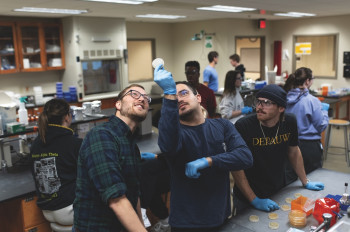
Without a foundation in the liberal arts and sciences, with its sturdy base and its interwoven network of inquiry, an education can become solely a process through which students acquire a particular set of skills. But that’s another tree altogether, a different species from the one which has grown at the center of DePauw for nearly 200 years, sustaining our students on paths of lifelong learning and uncommon success.
“Every discipline has its own vocabulary, its own ways of knowing. We want to give students the space and opportunity to make connections between them,” says Bridget Gourley, dean of the faculty, dean of the College of Liberal Arts and Sciences and professor of chemistry and biochemistry.
Academic disciplines, and the way faculty ask students to connect them, motivate students to continually observe how one class informs another. This is a prized and intrinsic outcome of our liberal arts mission. Fellows and interdisciplinary programs, as well as individual classes that draw from different disciplines, take that spirit one step further, creating structures through which students can even more intentionally explore the connective tissue of knowledge.
Every discipline has its own vocabulary, its own ways of knowing. We want to give students the space to and opportunity to make connections between them.– Bridget Gourley, Dean of College of Liberal Arts and Sciences
“High-impact learning practices,” Gourley says, “like first-year seminars, winter and May term trips and faculty/ student research opportunities” complete the picture.
Students experience the culture, art and cuisine of diverse countries, witness in person what had once been only a photo in a class lecture and engage in hands-on learning that exemplifies the spirit and necessity of collaboration and cross-pollination.
FIRST-YEAR SEMINAR
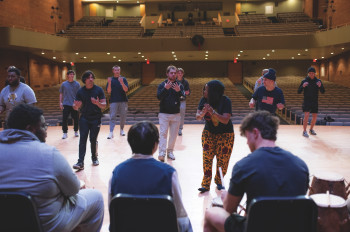
First-year seminars are many students’ first experience with the concept that not all college learning is contained within distinct subject areas. Though not every first-year seminar is interdisciplinary, many are. All are tight-knit learning environments centered on discussion and writing, designed to open new areas of interest and allow students to think in new ways.
 Harry Brown, professor of English and co-director of the Environmental Fellows Program, teaches a first-year seminar called The Magic Circle, Introduction to Ludology, which combines computer science, history, sociology, storytelling, psychology, art and design. Ludology is the study of games and play. “The class asks formal analysis questions like, ’What makes a game a game?’ ’What is the difference between games and play?’ ’Do animals play?’”
Brown explains. “We do historical analysis, following the progression of games over time, looking at how games impact or are impacted by the values of a particular culture. We ask, ‘Where does game design meet storytelling?’”
Students are assigned design exercises to implement what they take away from reading and analysis, and over the semester they design a board game, a text-adventure game (interactive fiction, utilizing AI), a prototype for an open-world video game (which draws from the world building of literature or film) and a social game (a non-digital alternate reality or role-play game). Students pitch their ideas as if trying to sell them to a development company and learn about the business of game production, as well.
“The gravitational center of the class is ‘fun,’” says Brown. “It’s something everyone has experienced, but what do those experiences have in common? How do you design an experience that is ‘fun’? I had [students from] six countries in my class last fall. Play and fun are universal.”
FELLOWS PROGRAMS
Fellows programs are unique student opportunities within the CLAS that gather expertise from various disciplines under what might be called umbrella areas. They complement a student’s major rather than replacing it.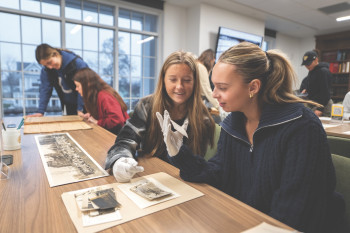
Carrie Klaus, professor of global French studies, is the current director of the Global Studies Fellows Program.
“It’s an open-entry program,” she says. “It requires no interview and is accessible to any interested student. Students choose a regional track – such as Africa, Latin American and the Caribbean, Europe or East Asia and Oceania – and a thematic track – such as sustainability; health and the environment; global STEM; or global commerce, politics and international relations. Unlike a lot of global studies programs, at DePauw, students come to the program through the humanities rather than through the social sciences.”
Standard curriculum is essential, but solutions to problems need people who can think across boundaries. These courses prove that knowledge is fluid.– Rebecca Schindler, Professor of classical studies, Honor Scholars director
It requires a course, for example, in Translating Worlds (such as a world literature, cinema or art history class), as well as a language requirement beyond DePauw’s general education requirement. All global fellows complete a global educational experience, too, such as a semester abroad, summer internship, faculty-student research or a winter or May term abroad.
The Honor Scholar Program directed by Rebecca Schindler, professor of classical studies, is another fellows program designed for students and faculty to explore across and beyond traditional disciplines, but it is not defined by any particular content area.
“Partly because our world is always changing, our issues and topics evolve with it,” says Schindler. “Standard curriculum is essential, but solutions to problems need people who can think across boundaries. These courses prove that knowledge is fluid. Honor Scholar students are passionate about challenging issues, excited by ideas and critical inquiry.”
The Honor Scholar Program is based on inquiry, interdisciplinarity and integration leading to innovative ideas and arguments. The program has its own requirements, but most of its courses are open to all students.
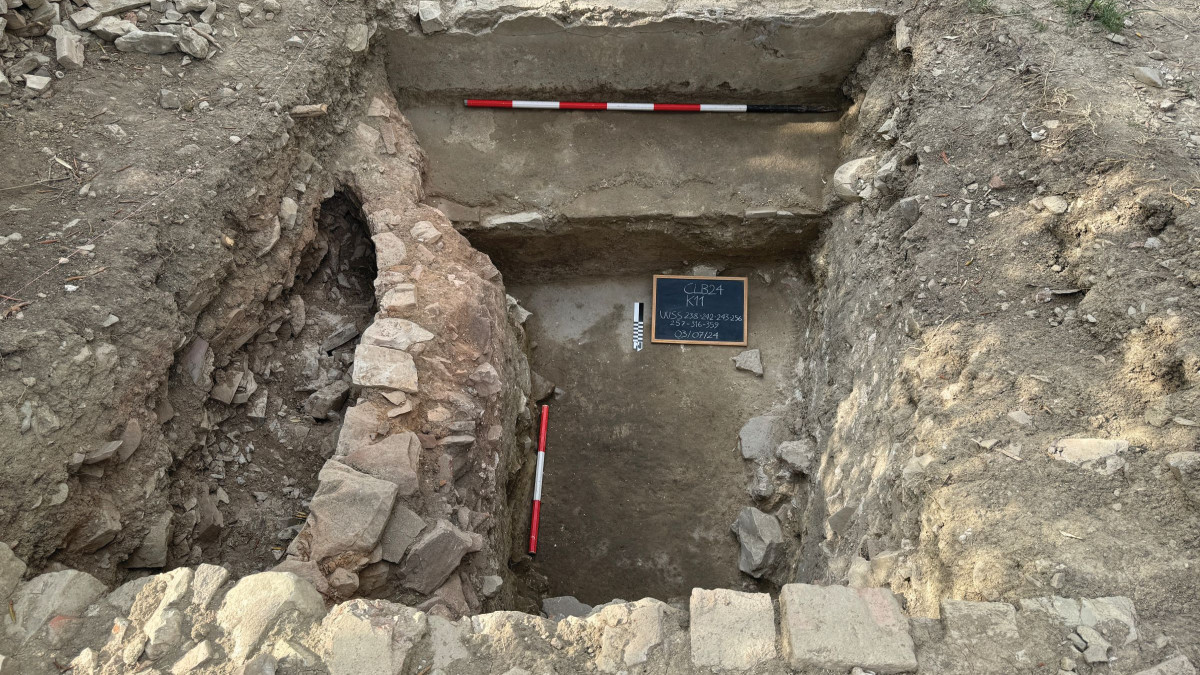
One such course is Schindler’s Culture in Context and Conflict that looks at archaeological heritage across disciplines. She explains: “We’re asking questions like, ‘Who are the stakeholders responsible for protecting and preserving cultural heritage across the globe?’
' Is art a commodity (looking at sales, museums and collectors)?' If you’re not displaying your own cultural heritage, what responsibility do you have to the indigenous?’ We look at international law, too. The black market in antiquities is the third-largest black market in the world after guns and drugs. I’m a field archaeologist. I’ve seen firsthand what happens when those sites are looted.”
The class blends politics, economics, museum studies, art history and archaeology, the kind of high-level integrative exploration that is the core of Honor Scholar at DePauw.
INTERDISCIPLINARY PROGRAMS
Interdisciplinary programs, like Africana studies, film and media arts, religious studies, and women’s, gender and sexuality studies, center the idea of integrative learning. They draw professors from various subject areas to supplement core faculty and offer students alternatives to departmental majors and minors. Dave Berque, vice president for academic affairs explains, “Interdisciplinary programs play a key role in helping students learn to explore topics through multiple lenses. Although I am a computer scientist, I periodically co-teach a winter term travel course titled Japanese Culture, Technology and Design. The course is listed in the interdisciplinary Asian Studies Program and leverages the approaches of multiple disciplines to help students gain a more integrative understanding of an important part of the world.”
“Interdisciplinary programs are a powerful and important part of the CLAS and a big part of what a liberal arts institution is about: seeing connections across disciplines and, in our case, what’s going on in the world,” says Rachel Goldberg, associate professor of peace and conflict studies and director of the Peace and Conflict Studies Program.
“One of our program’s aims is to give students the ability to see structures,” Goldberg says. “It’s problematic to try and make sense of the behaviors of groups out of context. You have to understand the structures behind them – structures like the education system, the media, the justice system, the economic system – which create barriers or advantages for particular groups. With that awareness, we can address issues in a more effective way, challenge entrenched narratives and make new ones.”
Goldberg also trains students as mediators through a class called Applied Conflict Analysis and Resolution, a certification highly useful in daily life, as well as one that can move student resumes to the top of the pile.
Undergraduate research is a DePauw CLAS signature. Sarah Mordan-McCombs ’03, associate professor of biology, wants to get as many students as possible involved through course-based undergraduate research experience (CURE).
“Not every student has the time in their schedules for programs like Science Research Fellows or working outside of class,” Mordan-McCombs says. “Integrating research into classwork helps them see what the process of discovery looks like and how textbook content lines up with what real life scientists are trying to answer.”
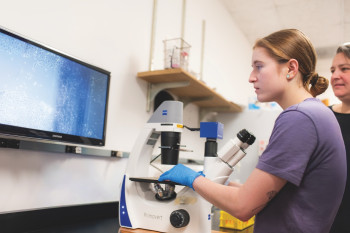
Students in Mordan-McCombs’ molecular biology class are currently testing a potential new chemotherapeutic drug. In an elegant example of interdisciplinarity, Mordan-McCombs’ work comes together with her previous professor, Jeffrey Hansen, professor of chemistry, who synthesizes the drug, which involves designing and making molecules, then gives Mordan-McCombs’ class the molecule. Colleen Doci, another associate professor of biology, and Nipun Chopra ’06, associate professor of psychology and neuroscience, test the drugs in different cancer cells (breast, head, neck and skin), through a combination of independent research and classwork.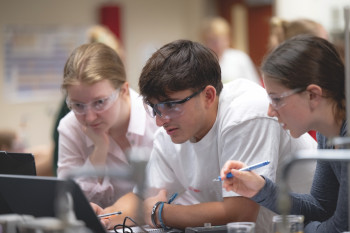
“The drug is killing the cancer cells,” Mordan-McCombs says. “The next big questions are, ‘How does it work?’and ‘Can we use it successfully without harming the patient?’” DePauw alum Marina Xie ’19 created a fluorescent dye that links to the drug, so the class can watch where it goes and what it does in the cell. Yet another alum Mishal Ali ’22 is working on computational modeling to determine proteins in the cell with which the drug might interact.
“Students are getting to see lots of parts of the process, which would be highly unusual in a larger institution,” concludes Mordan-McCombs. “But collaboration and interdisciplinarity are true to how drug discovery works.”
EXTENDED STUDIES
Extended studies trips are some of the most impactful experiences our students have at DePauw, so our alums say.
Pedar Foss, archaeologist and professor of classical studies, has been leading a winter term course to various sites in Europe every few years with the soccer team since 2011.
One such trip took place in Belgium and the Netherlands this past winter term in collaboration with Nipun Chopra. There, DePauw team members trained with coaches at the Netherlands and Belgium national team training headquarters. Off the field, they began with the history and architecture of sport.
“The Dutch are famous for their theoretical and practical perceptions of space on the soccer field,” Foss says. “We learned about how human beings perceive, measure and exploit space itself, and not just on a soccer pitch. Space is time.”
Coaches from the Royal Dutch Football Center worked directly with students on these theories in a classroom setting, and students, in turn, took what they learned onto the field.
“Meanwhile, we traveled around the Netherlands, looking at Dutch
architecture and art to see how space gets expressed and the ways it relates to the same concepts in soccer,” Chopra says. “We looked at places and spaces from the Roman period all the way through the 20th century.
“Our students came to understand the neurobiological and physiological ways our brains process space in the world,” Chopra, an expert on head injury in soccer players, explains. “How we judge distances, identify where our own bodies are in space, analyze geometrical relationships and make correct decisions. With the dynamic nature of soccer – and its constantly changing patterns – delays or errors in decision-making often separate top-level players from average ones. We discuss how to optimize that decision-making.”
Students integrated these ideas with their playing experience and their travels across the Netherlands, making cultural, artistic, neurological and physical connections all in the context of their sport.
“Personally,” Foss adds, “I liken soccer to jazz. Everybody knows the song, but there’s constant improvisation. You’re coming together with 10 other players in synchronicity and harmony to achieve a ‘goal.’”
Meanwhile, we traveled around the Netherlands, looking at Dutch architecture and art to see how space gets expressed and the ways it relates to the same concepts in soccer.– Nipun Chopra, associate professor of psychology and neuroscience
BUSINESS MEETS HUMANITIES
The College of Liberal Arts and Sciences informs every aspect of study at DePauw.
In fact, faculty and administration approved the School of Business and Leadership with a specific goal in mind: to offer a top-tier business and finance education buttressed by courses that emphasize critical and ethical thinking.
Erik Wielenberg, professor of philosophy, teaches a class called Free Market Capitalism and Human Nature, which asks, ‘What happens when you put humans into a market-driven system?’ The class, among others, counts for DePauw’s Management Fellows Program ethics requirement.
“Adam Smith’s ‘The Wealth of Nations,’ written in 1776, has had a major influence on modern free market capitalism,” Wielenberg says. “Smith envisions a system where everyone is motivated to make as much money as they can, so they specialize in a job they’re good at. The jobs that pay the most produce what people want the most. So, though humans are motivated by self-interest, by producing what consumers want, they end up serving the public interest or common good.”
But it turns out actual human beings are far more complex. Economics predictions fail, partly because of this oversimplification of human nature, and the class looks at real-life examples, such as the 2008 housing and economic crisis.
“No economists predicted it,” says Wielenberg. “The model assumes our preferences are fairly stable over time, but psychology research shows that, because we have emotions that quickly come and go, our preferences are, in fact, predictably irrational. Another assumption is that the more people get what they want, the better off they are. But as we can see in an obvious example like addiction, what initially made someone happy can eventually make them unhappy. Evolutionarily, humans were drawn to sweet things for survival, but in the long run, they no longer bring us well-being. Questions about what actually does make people happier brings philosophy into the mix.”
Recently, DePauw was awarded a grant from the National Endowment for the Humanities, led by director of the Prindle Institute for Ethics Jeffrey Dunn, called Business Meets Humanities, aimed at bringing together ideas from humanities disciplines to dovetail with business in exciting and innovative ways.
It’s one of many steps being taken at DePauw to meet new challenges with the breadth and depth of knowledge across the curriculum.
The tree that is the College of Liberal Arts and Sciences allows us access to heights we might never have thought reachable, offering vistas we might never have otherwise imagined. It provides beauty when we forget how to look for it, shade when we need shelter, sustenance when we need nourishment; it provides the materials we need to build new things.
DePauw is privileged with the enterprise of growing and safeguarding this extraordinary resource poised to fortify and inspire us long into the future.
DePauw Magazine
Spring 2026
 Buried No More
 The Tree of Learning
DePauw Stories
A GATHERING PLACE FOR STORYTELLING ABOUT DEPAUW UNIVERSITY
Browse other stories
-
Athletics
-
Field Hockey - Tigers Claim Season Opener 4-2 Against Centre
-
Women's Soccer - Sara Jacobi Scores Hat Trick in Season Opener
-
Men's Soccer - Tigers Start Strong with a 2-0 Win against Trine in Season Opener
More Athletics
-
-
News
-
DePauw and Wabash Announce Venue for 132nd Monon Bell Classic
-
DePauw Earns Positive Outlook from Moody's, Backed by Record Philanthropy and Financial Growth
-
DePauw Students Return to Top Three of Risk Management Competition
More News
-
-
People & Profiles
-
In Brian Wright’s Lab, Student Research Meets Real-World Impact
-
Empie, Party of Five: One Family’s Unique DePauw Bond
-
Entrepreneurs Eric Fruth ’02 and Matt DeLeon ’02 Are Running More Than a Business
More People & Profiles
-
-
Have a story idea?
Whether we are writing about the intellectual challenge of our classrooms, a campus life that builds leadership, incredible faculty achievements or the seemingly endless stories of alumni success, we think DePauw has some fun stories to tell.
-
Communications & Marketing
101 E. Seminary St.
Greencastle, IN, 46135-0037
communicate@depauw.eduNews and Media
-
News media: For help with a story, contact:
Bob Weaver, Senior Director of Communications.
bobweaver@depauw.edu.