Increasingly Human
Harry Brown does not approach AI as simply another tool to adopt or resist. Instead, he sees it as a force prompting higher education to ask what remains distinctly human.
by Sarah Steinkamp, vice president for communications and strategy and chief of staff
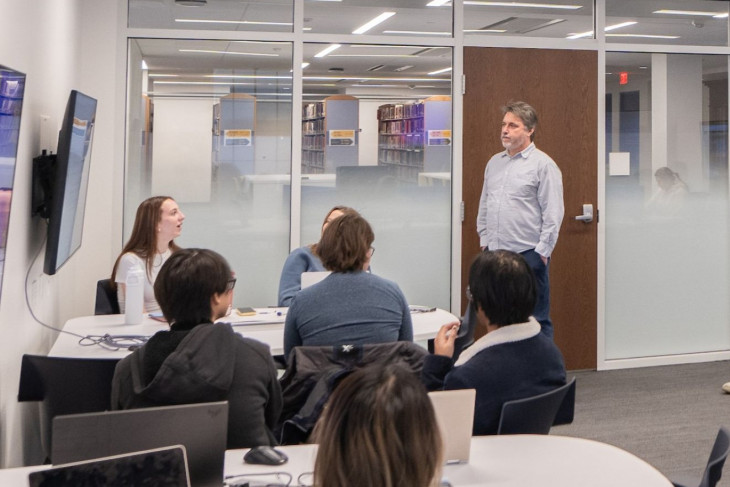
When Harry Brown, professor of English and co-director of the Environmental Fellows Program, considered artificial intelligence in the context of his new role as Tenzer Family University Professor in Instructional Technology, his reflections on the impact of AI were striking. Brown, a humanist by training and disposition, does not approach AI as simply another tool to adopt or resist. Instead, he sees it as a force prompting higher education to ask what remains distinctly human.
At first glance Brown may seem an unlikely figure to help shape DePauw’s future with AI. Known for his deep connection with students, he brings to the conversation not only curiosity but also a clear sense of responsibility. In his new position, he sees an opportunity to advocate for the continued importance of keeping humans (and the humanities) centered, while exploring the ethical, cultural, educational and environmental questions that AI prompts.
“Among humanists like me, there’s a hopeful view that AI will make the humanities more relevant, not less,” he says, “because ‘human’ is something it can’t do. AI needs a ‘human in the loop,’ and humanists are naturally suited to that role by virtue of our historical awareness, attentiveness to language and ethical and aesthetic training.
“The Tenzer position gives me a platform to advocate for humans and humanities in the loop, to explore AI ethics and what ‘humanistic AI’ might mean and to support sustainable AI adoption on campus and beyond. I’m excited to help guide DePauw through this watershed, and I’m wary about what can go wrong if we veer too far toward enthusiasm on one side or skepticism on the other.”
For Brown, the significance of this moment becomes clearer when placing AI in historical context. In his courses, he situates these changes alongside earlier technological shifts that transformed the way we learn, write and communicate. But he also argues that AI is different in kind, not just degree.
Unlike earlier technologies, he suggests, AI reaches closer to human intelligence itself, which is why it raises a more unsettling question: “If it’s not human, what is it if it does what we do, often better than we do it?”
For Brown, that thought is exactly what makes this moment so consequential. AI is not simply a tool for completing tasks more efficiently, but one that may force us to change our understanding of what being human really is.
“We didn’t think of the smartphone as threatening our souls or becoming conscious, right?” he says. “If it can write novels, make music, make art, solve math conjectures, then we have to figure out what we are and what we can do that it isn’t and can’t do. It can do lots of things that we can’t do, but it can’t successfully simulate the emotional exchange that underlies intellectual communication or information sharing.”
The question, as Brown sees it, is not simply what AI can do, but what kind of human experience education should preserve. Pandemic teaching and remote classrooms made clear for many the difference between access to information and the full experience of learning together. In his classroom, Brown protects the social and interpretive space where students can grapple with ambiguity, test ideas and be shaped as thinkers by their peers and their faculty.
“Learning is, by essence, social,” he says. “The emotional intelligence involved in teaching and learning, embodiment or worldliness – students need it. They need to feel good about what they’re doing other than just receiving information or expertise.”
It can sometimes feel as though humanity is using AI for everything and that we are already collectively in favor of its rapid expansion. Brown does not see that response in every classroom. In ENG 395: AI and the Future of Writing, a class largely made up of creative writers and journalism students, he encountered a notably resistant reaction.
“The majority attitude was, ‘I hate AI, and I hate what it’s doing to my field,’” he says. “But by the end of the semester it was, ‘I still hate AI, but I understand myself better as a writer.’”
That reaction matters to Brown because it suggests that students who identify as writers are also pushing back against what can feel like the anti-humanness of tidy, automated work. Increasingly, they seem to be finding a sense of humanness in imperfection, much as anti-AutoTune musicians or anti-Photoshop photographers have insisted on the value of texture, friction and visible process.
In practice, Brown’s classroom philosophy places the emphasis on process. Students may use AI to test ideas, follow leads and explore new paths in their learning, but the real learning happens when they slow down, reflect and decide what they themselves think. For Brown, that process of synthesis matters just as much as the finished product. It is also where he has found a surprising source of energy in AI use – not efficiency, but curiosity and whimsy.
“We mostly think of AI as a tool, a professional assistant, an efficiency amplifier, but it’s also a toy,” he says. “I like the playful potential of AI. It will indulge, in depth and without judgment, any idiosyncratic or irrational thought experiment or question that passes through my mind, and helps me give it scope, context and expression. This week, I used it to talk through the reasons a particular color of deep metallic red on a car hypnotized me. Obviously, these uses of AI have no practical or professional purpose [for me], but they fostered a curiosity that, I think, is the beginning of all learning.”
That sense of curiosity is central to Brown’s thinking and teaching. He suggests that playfulness can open the door to deeper intellectual work, precisely because it gives the mind room to wander.
Playful curiosity might seem unserious, especially when it sends us down rabbit holes or from one question to the next like a child asking “why.” But that mode of wondering has its own seriousness and can open deeper social and scholarly insight.
“In this sense, AI has a Socratic dimension, helping me, through playful questions and responses, to know myself in a way that I could not have done through solitary reflection, or even in conversation with another human who didn’t have a working knowledge of the neuroscience of color perception,” Brown says. “We can use it to explore unconscious thought, in the same way that Surrealist artists and writers a century ago used automatic writing and exquisite corpse drawing. In these ways, it’s posthuman in a way that’s fun and not scary. I think the Surrealists would have considered AI an idiot god, knowing everything and nothing at the same time.”
For Brown, that paradox is part of the point. AI may be powerful, and it may be increasingly capable, but it is still most useful when it helps sharpen, rather than replace, human thought. In that sense, his view of AI is complex. The task ahead, he suggests, is to remain attentive to what AI can reveal about human creativity, human judgment and the forms of learning that still require one person to help another make meaning.
Note: This profile appeared as part of a larger feature on artificial intelligence in the Fall 2026 issue of DePauw Magazine.
DePauw Magazine
Fall 2026
 What I'm Reading
 Beyond the Classroom: DePauw Learning Stretches Outward
 Increasingly Human
DePauw Stories
A GATHERING PLACE FOR STORYTELLING ABOUT DEPAUW UNIVERSITY
Browse other stories
-
Athletics
-
Football - Green Named NCAC Defensive Athlete of the Week and to the D3football.com Team of the Week
-
Men's Golf - Tigers Finish Fifth in Final Fall Tournament
-
Volleyball - DePauw Rallies for a 3-1 NCAC Win over Denison
More Athletics
-
-
News
-
DePauw and Wabash Announce Venue for 132nd Monon Bell Classic
-
DePauw Earns Positive Outlook from Moody's, Backed by Record Philanthropy and Financial Growth
-
DePauw Students Return to Top Three of Risk Management Competition
More News
-
-
People & Profiles
-
In Brian Wright’s Lab, Student Research Meets Real-World Impact
-
Empie, Party of Five: One Family’s Unique DePauw Bond
-
Entrepreneurs Eric Fruth ’02 and Matt DeLeon ’02 Are Running More Than a Business
More People & Profiles
-
-
Have a story idea?
Whether we are writing about the intellectual challenge of our classrooms, a campus life that builds leadership, incredible faculty achievements or the seemingly endless stories of alumni success, we think DePauw has some fun stories to tell.
-
Communications & Marketing
101 E. Seminary St.
Greencastle, IN, 46135-0037
communicate@depauw.eduNews and Media
-
News media: For help with a story, contact:
Bob Weaver, Senior Director of Communications.
bobweaver@depauw.edu.