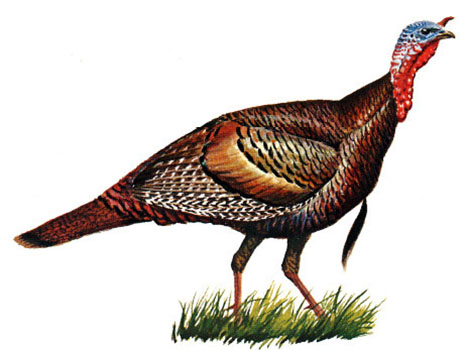
Wild Turkey
Meleagris gallopavo
Turkey family (Phasianidae)
A large bird. Body is dark brown, head and neck are bare. Male is larger and more iridescent than female and has a tuft of hairlike feathers (“beard”) on breast.
Habitat:
Forest, forest edges
Nesting:
Nest is placed in a slight depression on the ground, usually at the base of a tree or under a shrub. Eggs are large, whitish buff with brown marks. Young are precocial, leave nest soon after hatching, begin flying at 2 weeks of age.
Voice:
“Gobble gobble gobble” given by males during breeding season.
Name Origin:
The genus name Meleagris is from the Latin for "guinea fowl." The species name gallopavo is from the Latin for "cock" and "peafowl."
In the Nature Park:
Year-round resident. Wild Turkeys are common in the deep woods of the Nature Park.
Photos:
Wild Turkey male