Wood Duck
Aix sponsa
Duck family (Anatidae)
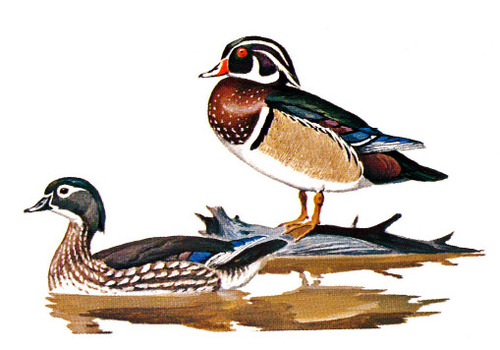
A small duck. Crested head, broad wings, square-shaped tail in flight. Male has a colorful head, white throat, large green crest, pink bill, red eye. Female has a brownish gray body, dark crown, white patch around eye.
Habitat:
Forested wetlands.
Nesting:
Cavity nester. Uses natural cavities in large trees or artificial nest boxes. Clutch size – 10 eggs. Eggs are white, creamy white, or dark tan; glossy. Chicks are precocial, downy, fly 8 to 10 weeks after hatching.
Voice:
“Hauk” or “oo-eek” call given by female in flight. Male call is a drawn-out “ji-ihb” or low squeaky “jeeb.”
Name Origin:
Aix is from the Greek for “waterfowl.” The species name sponsa is from the Latin for “betrothed,” i.e., dressed for a wedding, from the bird’s attractive appearance.
In the Nature Park:
Year-round resident.
Photos:
Wood Duck female (left) and male (right)