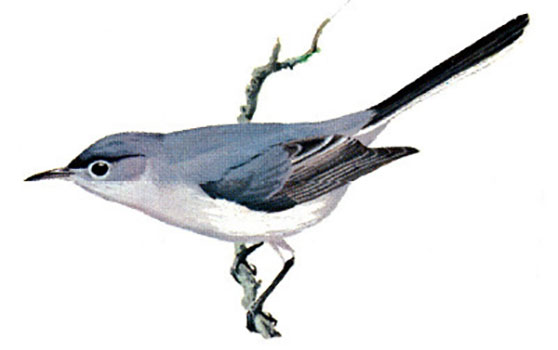
Blue-gray Gnatcatcher
Polioptila caerulea
Gnatcatcher family (Sylviidae)
A small slim songbird. Bluish-gray back and head, light gray below. Long tail is usually cocked upward or flicked from side to side. Tail is black above, white below. White eye ring.
Nesting:
Nest is a tiny cup made of plant fibers and spider webs and covered with bits of lichen. Nest is placed on a horizontal limb, 10 to 20 feet above the ground. Eggs are pale blue with dark spots. Clutch size – 4 to 5 eggs.
Voice:
Song is a complex rambling jumble of high-pitched phrases. Song is only heard early in the breeding season, during mid- to late March and early April. Call, heard throughout the spring and summer, is a thin high-pitched series of “zeeeee” notes.
Name Origin:
The genus name, Polioptila is from the Greek for “gray feather.” The species name caerulea is from the Latin for “blue.”
In the Nature Park:
Short-distance migrant, arrives mid-March to early April. Common in open woodlands throughout the Nature Park.
Photos:
Blue-gray Gnatcatcher