Commencement
Class of 2026 Commencement Ceremony
Sunday, May 17, 2026 at 10:00 a.m. Eastern
East College Lawn (located outside of the Emison building)
(Graduates arrive at 9:15a.m. at the sidewalk between Julian and Lilly)
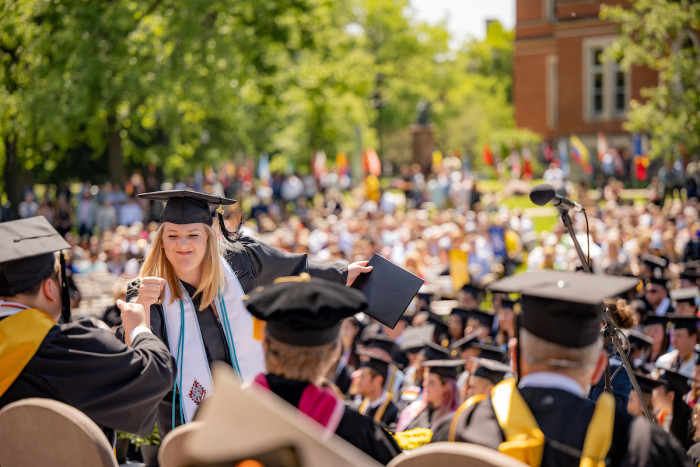
Commencement is a very special ceremony to officially confer degrees and celebrate the academic achievements of all DePauw graduates. Additional information will be shared on this site and through campus email to help ensure that all graduates have a memorable time with family, friends, guests, and the campus community.
Ordering Regalia
Graduates can order regalia (cap, gown, tassel) from herff.ly/depauw.
Ship to Bookstore Deadline:
- Place order by April 1
Ship to Home Deadline:
- Place order by April 24
Important policies related to regalia:
- Traditional black regalia is required at commencement.
- Any additional adornments added to traditional black regalia (cap and gown) must represent excellence in higher education and academic performance at DePauw University.
- Anything that is raised or that does not denote a positive message on the traditional board cap) must be removed.
Overnight Lodging
Guests are encouraged to seek overnight lodging arrangements in Greencastle, IN or nearby towns. Housing will not be available on campus for guests.
Additional information
- Accessibility Accommodations: For questions about accessible seating for guests or to request accommodations (including language translation or ASL services), please contact Heather Wright at 765-658-1087 or heatherwright@depauw.edu by Friday, May 8, 2026. To accommodate as many families as possible, accessible seating is limited to the individuals requiring assistance plus two guests. Additional family members/guests are welcome to enjoy the Commencement ceremony from the general seating area.
- Professional Photos: Commencement day graduate photos will be taken by GradImages. Ordering information and promotions are available on their website.
- Inclement Weather: Commencement will take place outside, rain or shine, unless there is a lightning storm. Instructions will be shared as soon as possible if we have to move indoors.
Schedule of events:
Friday, May 15
10:00 A.M. - Noon - Commencement Rehearsal
Lilly Physical Education and Recreation Center, Neal Fieldhouse
Rehearsal will be held for all graduates at Lilly Physical Education and Recreation Center, Neal Fieldhouse (more details forthcoming from the University Marshal).
Immediately after commencement rehearsal - Welcome to the GOLD Life!
The Robert G. Bottoms Alumni and Development Center
Join the GOLD Alumni Board at the Robert G. Bottoms Center for Alumni & Development as they welcome your Class of 2026 to the Alumni Association with a champagne toast, light lunch, and a Class of 2026 gift for each new grad.
Saturday, May 16
4:00 P.M. - Baccalaureate
Green Center for the Performing Arts, Kresge Auditorium.
(Graduates arrive at 3:30 p.m. at the lower level of the Green Center nearest Lilly)
The Baccalaureate Celebration Ceremony kicks off the first formal event of Commencement Weekend, during which President White addresses the graduating class. The celebration includes prayers and readings from many traditions, as well as inspiring music, reflections from student leaders. Tickets are not required.
Live stream available at depauw.edu/stream
5:00 P.M. - 7:00 P.M. - Senior Dinner
Hoover Hall
Celebrate the accomplishment of the graduating seniors with an elevated dining experience conveniently located in the heart of campus! Enjoy deliciously designed action stations including a made to order pasta bar, meat carving station, full salad bar, house-made dessert spread and so much more! Join as we transform Hoover Hall into an unforgettable dining experience. All are welcome, make your reservation today! Bon Appetit at DePauw University - Greencastle, IN (catertrax.com)
8:00 P.M. - 10:00 P.M. - DePauw Under the Stars
Stewart Plaza (Inclement weather location Hoover Hall and the Union Building Living Room)
An evening of music and conversation for graduates and their families/guests.
Sunday, May 17
10 A.M. - Commencement Ceremony
East College lawn
(Graduates arrive at 9:15 a.m. at the sidewalk between Julian & Lilly)
Tickets are not required for the outdoor ceremony, but will be necessary if we have to move commencement indoors (only in the event of inclement weather). Each graduate can reserve up to 5 e-tickets for their family and guests.
(Please only reserve the number of tickets that you actually will need, if less than 5).
To reserve and download the inclement weather e-tickets, please use the EventBrite link by Wednesday, May 13th at 4:00 p.m. (NOTE: Your student ID number is your access code for e-tickets). Please make sure that you give your family and guests the e-tickets before the day of the commencement. For EventBrite/ticketing questions, please contact Joe Novak at joenovak@depauw.edu.
Note: graduates processional line up will begin at 9:15 a.m. - more details forthcoming from the University Marshal
Live stream available at depauw.edu/stream
All arrangements are subject to change. Graduates will be notified via campus email.
We appreciate your continued patience as we work to plan special celebrations. Health and safety protocols will be in place per campus guidelines.